Waste water is more than just mud. In some industrial processes it is full of valuable raw materials, such as traces of the rare metal gallium. In order to recover them, researchers from Freiberg have now tested a new biotechnical process — and filtered metal ions out of the wastewater using a peptide gel.
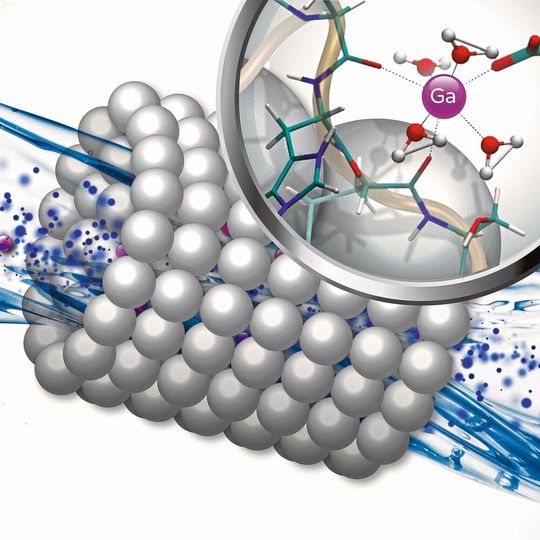
Special peptide compounds in the form of a filter act as a biological fishing rod to dissolve gallium out of industrial wastewater.
(Source: HZDR/Sahneweiß)
Dresden/Germany — Our high-tech world would be unthinkable without rare metals because they are found in many devices and systems that surround us. Many of these metals have a lower natural occurrence and are difficult to mine, which is also associated with high costs. This is why recycling plays an even more important role. By recovering the rare metals from industrial wastewater, slag or devices that are no longer in use, they can be returned to the recycling cycle. HIF researchers led by Dr. Katrin Pollmann have demonstrated that selective biosorption, i.e. the ability of certain microorganisms such as bacteria, yeasts, fungi, and algae to enrich themselves with metals or metal ions, is a suitable process for the recovery of gallium from industrial wastewater.
We find this high-tech metal, for example, in light-emitting diodes and solar cells; it serves as a coating for mirrors and is used in medicine for tumor diagnostics. It is mainly used in the semiconductor industry. In conjunction with arsenic, it is used as gallium arsenide for wafer production. Most of the industrial gallium is lost during production. Nevertheless, gallium is of increasing importance for the industry. A high recycling rate from the gallium-processing industry is all the more important since they represent a much richer and more important source for secondary gallium production.
Bio-Recycling — Ecological Alternative to Classical Separation Processes
Previous recycling processes for the production of gallium are often based on chemical electrolysis processes. The very energy-intensive electrolysis produces waters, which leads to the dilution of valuable substances and the increase in salinity of the wastewater. The situation is different with so-called biocomposites, they are recyclable and can be used again and again in separation processes. This innovative recycling method includes processes that use biological systems to extract metal from ores or waste materials. The release of metals can occur directly through the metabolism of microorganisms or indirectly through their metabolic products.
"Biosorption is an environmentally friendly alternative to recovering metals from industrial wastewaters, leaching solutions or mine waters."
One of these bio recycling processes is biosorption. “The biomass binds certain ions or other molecules in an aqueous solution or concentrates them. Biosorption is not dependent on metabolic activity and does not require the supply of nutrients. This enables biosorption to be used even in highly toxic environments. Biosorption is therefore an environmentally friendly alternative to recovering metals from industrial wastewaters, leaching solutions or mine waters,” explains Katrin Pollmann, leader of the biotechnology department at HIF. The challenge, however, is to find the appropriate biomolecules.
Peptides as a Fishing Rod
The Freiberg scientists are working on specialized biosorption materials that are able to specifically recognize individual elements, bind them selectively and thus remove them from solutions. They use peptides, which are small proteins made up of amino acids. “Peptides are small and therefore robust which makes them particularly suitable. There are 20 naturally occurring amino acids that have different properties and can be linked together in a freely combined peptide chain. This creates biomolecules that are able to sit on every conceivable surface and recognize them very specifically. The right peptides are selected with the help of the Phage Surface Display method,” describes HIF scientist Dr. Nora Schönberger.
This method focuses on bacteriophages, meaning viruses that are specialized in infecting bacteria. The element-specific peptides are firmly anchored on a carrier material with certain properties. The resulting biocomposites “fish” the target substances from a complex mixture of materials due to the unique peptide structures. Peptides thus enable selective metal recovery.
Biotechnological Approach with Gallium-Binding Peptides
As part of the project “Ecogain”, in which the extraction of gallium from production wastewater from the semiconductor industry was examined, Schönberger has dealt in detail with the identification of gallium-binding peptides. “We used chromatopanning, a technique that selects peptides that bind to a specific target. With the help of this separation process, we isolated the special peptides that capture the gallium ions from the process wastewaters,” Schönberger explains and continues: “For the biosorption studies, I packed a peptide-based filter material in a column and built a kind of gallium filter through which the wastewaters could run. The material is well suited if it retains the gallium in the filter material as efficiently as possible, while the other contaminations that are contained in the process wastewaters, above all arsenic, simply flow off. Subsequently, the gallium bound to the filter material must be able to be separated from the column in order to recover the gallium.”
One of the five tested peptide filter materials in these experiments was shown to be particularly suitable for efficiently recovering gallium. “The use of biological systems in resource technology complements the repertoire of conventional metallurgical processes. It currently fills a methodological niche by making metals accessible that cannot be efficiently exploited with classical metallurgical approaches,” Pollmann says. However, this method has to be further developed for industrial application, since the chemical synthesis of the peptides for economic use in resource technology is too expensive and not yet sufficiently environmentally friendly. Furthermore, it is important to optimize the peptides that a better metal binding capacity is achieved and thus a more efficient use is possible.
Date: 08.12.2025
Naturally, we always handle your personal data responsibly. Any personal data we receive from you is processed in accordance with applicable data protection legislation. For detailed information please see our privacy policy.
Consent to the use of data for promotional purposes
I hereby consent to Vogel Communications Group GmbH & Co. KG, Max-Planck-Str. 7-9, 97082 Würzburg including any affiliated companies according to §§ 15 et seq. AktG (hereafter: Vogel Communications Group) using my e-mail address to send editorial newsletters. A list of all affiliated companies can be found here
Newsletter content may include all products and services of any companies mentioned above, including for example specialist journals and books, events and fairs as well as event-related products and services, print and digital media offers and services such as additional (editorial) newsletters, raffles, lead campaigns, market research both online and offline, specialist webportals and e-learning offers. In case my personal telephone number has also been collected, it may be used for offers of aforementioned products, for services of the companies mentioned above, and market research purposes.
Additionally, my consent also includes the processing of my email address and telephone number for data matching for marketing purposes with select advertising partners such as LinkedIn, Google, and Meta. For this, Vogel Communications Group may transmit said data in hashed form to the advertising partners who then use said data to determine whether I am also a member of the mentioned advertising partner portals. Vogel Communications Group uses this feature for the purposes of re-targeting (up-selling, cross-selling, and customer loyalty), generating so-called look-alike audiences for acquisition of new customers, and as basis for exclusion for on-going advertising campaigns. Further information can be found in section “data matching for marketing purposes”.
In case I access protected data on Internet portals of Vogel Communications Group including any affiliated companies according to §§ 15 et seq. AktG, I need to provide further data in order to register for the access to such content. In return for this free access to editorial content, my data may be used in accordance with this consent for the purposes stated here. This does not apply to data matching for marketing purposes.
Right of revocation
I understand that I can revoke my consent at will. My revocation does not change the lawfulness of data processing that was conducted based on my consent leading up to my revocation. One option to declare my revocation is to use the contact form found at https://contact.vogel.de. In case I no longer wish to receive certain newsletters, I have subscribed to, I can also click on the unsubscribe link included at the end of a newsletter. Further information regarding my right of revocation and the implementation of it as well as the consequences of my revocation can be found in the data protection declaration, section editorial newsletter.




:quality(80)/p7i.vogel.de/wcms/92/ad/92adbafb37924cea35ea3cf05b7a23e5/0130206318v2.jpeg "The world’s first fully functioning proof-of-concept quantum battery
(Source: Csiro)")
:quality(80)/p7i.vogel.de/wcms/9f/8b/9f8bc2b8491d7a514ca154e9588a07b7/0130205846v1.jpeg "The researchers’ new material, based on mineralised sawdust, is an excellent fire retardant. (Source: Dan Vivas Glaser / from Kürsteiner R et al. Chem Circularity 2026)")
:quality(80)/p7i.vogel.de/wcms/fd/73/fd73fcb3ceda89d1419de1083fcab7b4/0130081520v2.jpeg "The fingers at the heart of this technology were inspired by the fin-ray effect — a design principle derived from the natural structure of fish fins. (Source: University of Texas at Austin )")
:quality(80)/p7i.vogel.de/wcms/fe/64/fe649767c802d53ac63ee2c2a40b7e0d/0130060830v2.jpeg "Sample tube with light-active substance (Source: Elvira Eberhardt / Ulm University)")
:quality(80)/p7i.vogel.de/wcms/8f/b9/8fb98a958e4afe679865fbe52a473680/0129940982v2.jpeg "pH measurement in various nanoparticles using the Nine-Focus meter ensures precise stability and performance control. (Source: Mettler Toledo)")
:quality(80)/p7i.vogel.de/wcms/11/74/1174e5d4c8b07a64637dced8c9506b40/0129787561v2.jpeg "The Multicell Plus high-pressure reactor sets a new benchmark for operator safety, all-round accessibility and ease-of-use. (Source: Asynt)")
:quality(80)/p7i.vogel.de/wcms/ef/6e/ef6e96191183411973b77041fb6b1e16/0129785957v2.jpeg "Manufactured from high-quality crystal polystyrene - these new automation-ready plates are available in a choice of ANSI / SLAS standard (96-well and breakable 8-well strip) formats. (Source: Porvair Sciences)")
:quality(80)/p7i.vogel.de/wcms/ad/ca/adcaa20ef5ccaf7e3b325788b1e349c4/0129784872v2.jpeg "The high performance Degasi Flat Film in-line degasser. (Source: Biotech Fluidics)")
:quality(80)/p7i.vogel.de/wcms/e9/9c/e99cb19231197af70c489cb4acc2ead0/0130293444v2.jpeg "A new global study, led by researchers at Kaust in Saudi Arabia, shows that forests are most effective for climate regulation when conserved or restored in their natural or native locations. (Source: Kaust )")
:quality(80)/p7i.vogel.de/wcms/af/40/af40b535eb65c287fbd22ed5483d1d0e/0130206243v2.jpeg "The researchers dug soil pits in order to measure the carbon storage in soil
(Source: Johanna Asch)")
:quality(80)/p7i.vogel.de/wcms/2d/45/2d45aba62f5042baa00f7fd4fa629839/0130036533v2.jpeg "The population of Pune, India, is expected to reach 11 million by 2050. (Source: free licensed)")
:quality(80)/p7i.vogel.de/wcms/52/f8/52f8d5521fdab07ed0a865ec0d8919fd/0130009438v2.jpeg "Drylands support around half of global livestock production and sustain the livelihoods of close to a billion people, while also underpinning soil stability and carbon storage. (Source: Kaust )")
:quality(80)/p7i.vogel.de/wcms/6f/ba/6fba92196d0cbb1467334f8a2ecc520a/0130203021v2.jpeg "Low to moderate wine consumption shows lower risk compared with spirits, beer and cider (Source: free licensed)")
:quality(80)/p7i.vogel.de/wcms/a9/37/a9376f1d9a893570023d9aa97c085bc5/0129927485v2.jpeg "Examples of foods high in PUFAs include fatty fish and soybeans, while MUFAs include olive oil and avocadoes. (Source: free licensed)")
:quality(80)/p7i.vogel.de/wcms/ea/88/ea88ef8810e21cdd9bb852c70f385ba1/0129797385v2.jpeg "A team of NUS food scientists consisting of Assoc Prof Liu Shao Quan (centre), Dr Lu Yuyun (right) and Ms Geng Chenhan (left) pioneered a co-fermentation method that improves both the nutrient and flavor profile of kombu. (Source: NUS)")
:quality(80)/p7i.vogel.de/wcms/84/2c/842c7c1678ceeec7147ea3a36e238e75/0129356324v2.jpeg "Kaust and Nadec have signed a MOU that establishes a framework for long-term cooperation across agricultural research, technology development, and professional training. (Source: Kaust )")
:quality(80)/p7i.vogel.de/wcms/6e/b9/6eb95805568aa78dc2ed57f829cf33d4/0130300421v2.jpeg "A 10-minute digital program co-developed by a University of Texas psychologist significantly reduced symptoms of depression four weeks after use, according to results from one of the largest randomized controlled trials of single-session mental health interventions. (Source: University of Texas at Austin )")
:quality(80)/p7i.vogel.de/wcms/6f/e9/6fe9d920eca2c0b3bdeb55cbe9f01908/0130299237v2.jpeg "Study authors Jason Miska and Leah Billingham reading out enzymatic activity of microglia in cell cultures. (Source: Northwestern University.)")
:quality(80)/p7i.vogel.de/wcms/c4/54/c454661a9dd459cf7c5b632f79829358/0130284530v2.jpeg "The study shows that AI can be used to assess the build-up of calcium deposits in the arteries of the breast from the standard X-ray mammography scans that are currently used in routine breast cancer screening. (Source: ESC)")
:quality(80)/p7i.vogel.de/wcms/67/9b/679b140c164dbd7c4fe9eda4da91329b/0130281406v3.jpeg "This is the highest resolution molecular structure ever constructed of a key protein complex on the surface of the Andes virus, called the Gn-Gc tetramer, that enables it to infect cells. (Source: University of Texas at Austin)")
:quality(80)/images.vogel.de/vogelonline/bdb/1710600/1710675/original.jpg "Discover how to set yourself up for success when performing balance-based density determination of solids such as jewelry and precious metals. (Mettler Toledo)")
:quality(80)/images.vogel.de/vogelonline/bdb/1682500/1682579/original.jpg "The new XPR Analytical balance redesigned to meet the needs of laboratory technicians of working fast and lean. (Mettler Toledo)")
:quality(80)/images.vogel.de/vogelonline/bdb/1677000/1677080/original.jpg "Enhance your weighing accuracy, comfort and productivity with the redesigned XPR Analytical balance. (Mettler Toledo)")
:fill(fff,0)/p7i.vogel.de/companies/5f/3f/5f3f63ceedc78/knf-logo.jpg "KNF_Logo.jpg (www.knf.com)")
:quality(80)/images.vogel.de/vogelonline/bdb/1787700/1787701/original.jpg "With the project ISAr, scientists aim to develop a sustainable and low budget yeast cell-based sensor for the on-site detection of diclofenac in environmentally relevant concentrations in soil and wastewater. (Public Domain)")
:quality(80)/p7i.vogel.de/wcms/34/2e/342e07836d36c878a4e7f1899da31cb4/95275946.jpeg "Concept illustration of a water purification membrane with computationally designed, molecular-scale patterning of surface functional groups, which collectively function to reject a variety of molecular contaminants and foulants. (Source: Brian Long/ UCSB)")
:quality(80)/p7i.vogel.de/wcms/a0/4b/a04b6419b87a273acb68e69dfaff0fd9/0128938657v1.jpeg "A critical review of electrochemical strategies for selective uranyl recovery from radioactive wastewater and seawater. (Source: Juanlong Li et. al.)")
:quality(80)/p7i.vogel.de/wcms/1f/89/1f89ec33f25051fb58ffaecf907661c9/0124984189v1.jpeg "A magnetic sea urchin-shaped material (developed by Kist) is placed inside the pipe where wastewater flows in, and magnets are used on the outside of the pipe to induce self-assembly. The arranged urchin-shaped material can also be easily cleaned by adjusting the magnetic field when it is contaminated by suspended solids in the wastewater. (Source: Korea Institute of Science and Technology)")