A drug discovery method was used to identify naturally occurring metabolite that converts ‘bad’ fat to ‘good’ fat. This discovery offers a potential way of addressing metabolic conditions like obesity, type 2 diabetes and cardiovascular disease.
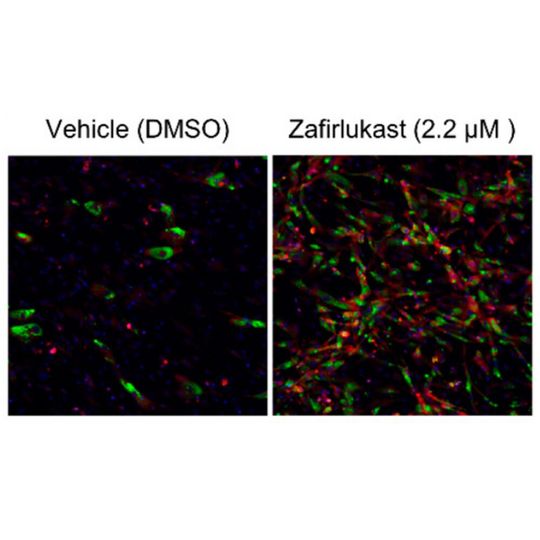
Zafirlukast induces the production of brown adipocyte tissue. For preadipocytes treated with zafirlukast (right image), brown adipocytes (shown in red) were much more prevalent than preadipocytes grown with the DMSO control (left image).
(Source: Scripps Research and Calibr)
Metabolism describes the body’s chemical changes that create the necessary materials for growth and overall health. Metabolites are the substances made and used during these metabolic processes — or, as a new discovery out of Scripps Research and its drug development arm, Calibr, indicates, they could also be potent molecules for treating severe diseases.
In a study from Metabolites published in August 2022, the researchers used novel drug discovery technologies to uncover a metabolite that converts white fat cells (“bad” fat) to brown fat (“good” fat) cells. The results speaks to the promise of using this creative drug discovery method to identify countless other potential therapeutics.
“The reason many types of molecules don’t go to market is because of toxicity,” says co-senior author Gary Siuzdak, PhD, the senior director of the Scripps Center for Metabolomics and professor of Chemistry, Molecular and Computational Biology at Scripps Research. “With our technology, we can pull out endogenous metabolites — meaning the ones that the body makes on its own — that can have the same impact as a drug with less side effects. The potential of this approach is even evidenced by the FDA’s recent approval of Relyvrio, the combination of two endogenous metabolites for the treatment of amyotrophic lateral sclerosis (ALS).”
Metabolic diseases are often caused by an imbalance in energy homeostasis — in other words, when the body takes in more energy than it expends. This is why certain therapeutic approaches have centered around converting white fat cells (known as adipocytes) into brown fat cells. White adipocytes store excess energy and can eventually result in metabolic diseases like obesity, while brown adipocytes dissolve this stored energy into heat — ultimately increasing the body’s energy expenditure and helping bring it back into balance.
To uncover a therapy that could stimulate the production of brown adipocytes, the researchers searched through Calibr’s Reframe drug-repurposing collection — a library of 14,000 known drug compounds that have been approved by the FDA for other diseases or have been extensively tested for human safety. Using high-throughput screening — an automated drug discovery method for searching through large pools of information — the scientists scanned Reframe for a drug with these specific capabilities.
This is how they uncovered zafirlukast, an FDA-approved drug used for treating asthma. Through a set of cell culture experiments, they found zafirlukast could turn adipocyte precursor cells (known as preadipocytes) into predominantly brown adipocytes, as well as convert white adipocytes into brown adipocytes.
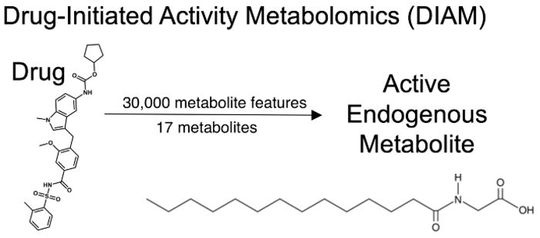
DIAM uses technologies such as liquid chromatography and mass spectrometry to pool through thousands of molecules and identify specific metabolites. In this case, the researchers first reduced 30,000 metabolic features to just 17 metabolites, and then found myristoylglycine—an active endogenous metabolite that was able to convert white fat cells to brown fat cells, similar to the drug zafirlukast.
(Source: Scripps Research and Calibr)
While an encouraging find, zafirlukast is toxic when administered at higher doses, and it wasn’t entirely clear how zafirlukast was converting the fat cells. This is when the researchers partnered with Siuzdak and his team of metabolite experts.
“We needed to use additional tools to break down the chemicals in zafirlukast’s mechanism,” says Kristen Johnson, PhD, co-senior author of the paper and a director in Translational Drug Discovery Research at Calibr. “Framed another way, could we find a metabolite that was providing the same functional effect that zafirlukast was, but without the side effects?”
Siuzdak and his team designed a novel set of experiments, known as drug-initiated activity metabolomics (DIAM) screening, to help answer Johnson’s question. DIAM uses technologies such as liquid chromatography (a tool that separates components in a mixture) and mass spectrometry (an analytical technique that separates particles by weight and charge) to pool through thousands of molecules and identify specific metabolites. In this case, the researchers were searching through adipose tissue for metabolites that could lead to brown adipocyte cell production.
After reducing 30,000 metabolic features to just 17 metabolites, they found myristoylglycine — an endogenous metabolite that prompted the creation of brown adipocytes, without harming the cell. Of the thousands of metabolic features measured in the analysis, only myristoylglycine had this special characteristic, even among nearly structurally identical metabolites.
“Identifying myristoylglycine among the thousands of other molecules speaks to the power of Siuzdak’s approach and these technologies,” adds Johnson. “Our findings illustrate what happens when an analytical chemistry team and a drug discovery group closely collaborate with each other.”
Date: 08.12.2025
Naturally, we always handle your personal data responsibly. Any personal data we receive from you is processed in accordance with applicable data protection legislation. For detailed information please see our privacy policy.
Consent to the use of data for promotional purposes
I hereby consent to Vogel Communications Group GmbH & Co. KG, Max-Planck-Str. 7-9, 97082 Würzburg including any affiliated companies according to §§ 15 et seq. AktG (hereafter: Vogel Communications Group) using my e-mail address to send editorial newsletters. A list of all affiliated companies can be found here
Newsletter content may include all products and services of any companies mentioned above, including for example specialist journals and books, events and fairs as well as event-related products and services, print and digital media offers and services such as additional (editorial) newsletters, raffles, lead campaigns, market research both online and offline, specialist webportals and e-learning offers. In case my personal telephone number has also been collected, it may be used for offers of aforementioned products, for services of the companies mentioned above, and market research purposes.
Additionally, my consent also includes the processing of my email address and telephone number for data matching for marketing purposes with select advertising partners such as LinkedIn, Google, and Meta. For this, Vogel Communications Group may transmit said data in hashed form to the advertising partners who then use said data to determine whether I am also a member of the mentioned advertising partner portals. Vogel Communications Group uses this feature for the purposes of re-targeting (up-selling, cross-selling, and customer loyalty), generating so-called look-alike audiences for acquisition of new customers, and as basis for exclusion for on-going advertising campaigns. Further information can be found in section “data matching for marketing purposes”.
In case I access protected data on Internet portals of Vogel Communications Group including any affiliated companies according to §§ 15 et seq. AktG, I need to provide further data in order to register for the access to such content. In return for this free access to editorial content, my data may be used in accordance with this consent for the purposes stated here. This does not apply to data matching for marketing purposes.
Right of revocation
I understand that I can revoke my consent at will. My revocation does not change the lawfulness of data processing that was conducted based on my consent leading up to my revocation. One option to declare my revocation is to use the contact form found at https://contact.vogel.de. In case I no longer wish to receive certain newsletters, I have subscribed to, I can also click on the unsubscribe link included at the end of a newsletter. Further information regarding my right of revocation and the implementation of it as well as the consequences of my revocation can be found in the data protection declaration, section editorial newsletter.
Refrences: Drug discovery method identifies naturally occurring metabolite that converts ‘bad’ fat to ‘good’ fat; Scripps Research Institute; Metabolites




:quality(80)/p7i.vogel.de/wcms/fd/73/fd73fcb3ceda89d1419de1083fcab7b4/0130081520v2.jpeg "The fingers at the heart of this technology were inspired by the fin-ray effect — a design principle derived from the natural structure of fish fins. (Source: University of Texas at Austin )")
:quality(80)/p7i.vogel.de/wcms/fe/64/fe649767c802d53ac63ee2c2a40b7e0d/0130060830v2.jpeg "Sample tube with light-active substance (Source: Elvira Eberhardt / Ulm University)")
:quality(80)/p7i.vogel.de/wcms/db/e2/dbe2ae4e02f702b30153a882ef705089/0129978032v1.jpeg "Each of the isolated indium atoms (in gold color) can catalyse the synthesis of methanol (top right). (Source: Constance Ko/ ETH Zurich)")
:quality(80)/p7i.vogel.de/wcms/c1/e6/c1e6ac26eb18993236c100e7f01a78f2/0129937639v1.jpeg "Dogs evolved from highly social ancestors and have been shaped by thousands of years of interacting with humans. (Source: free licensed)")
:quality(80)/p7i.vogel.de/wcms/8f/b9/8fb98a958e4afe679865fbe52a473680/0129940982v2.jpeg "pH measurement in various nanoparticles using the Nine-Focus meter ensures precise stability and performance control. (Source: Mettler Toledo)")
:quality(80)/p7i.vogel.de/wcms/11/74/1174e5d4c8b07a64637dced8c9506b40/0129787561v2.jpeg "The Multicell Plus high-pressure reactor sets a new benchmark for operator safety, all-round accessibility and ease-of-use. (Source: Asynt)")
:quality(80)/p7i.vogel.de/wcms/ef/6e/ef6e96191183411973b77041fb6b1e16/0129785957v2.jpeg "Manufactured from high-quality crystal polystyrene - these new automation-ready plates are available in a choice of ANSI / SLAS standard (96-well and breakable 8-well strip) formats. (Source: Porvair Sciences)")
:quality(80)/p7i.vogel.de/wcms/ad/ca/adcaa20ef5ccaf7e3b325788b1e349c4/0129784872v2.jpeg "The high performance Degasi Flat Film in-line degasser. (Source: Biotech Fluidics)")
:quality(80)/p7i.vogel.de/wcms/2d/45/2d45aba62f5042baa00f7fd4fa629839/0130036533v2.jpeg "The population of Pune, India, is expected to reach 11 million by 2050. (Source: free licensed)")
:quality(80)/p7i.vogel.de/wcms/52/f8/52f8d5521fdab07ed0a865ec0d8919fd/0130009438v2.jpeg "Drylands support around half of global livestock production and sustain the livelihoods of close to a billion people, while also underpinning soil stability and carbon storage. (Source: Kaust )")
:quality(80)/p7i.vogel.de/wcms/fe/49/fe494ada322615b6e6f6ff0f5bb7c5cf/0129926008v2.jpeg "A mandrill eating fruit. (Source: University of Bristol )")
:quality(80)/p7i.vogel.de/wcms/af/4e/af4ea968647ee9cae82b39800c611819/0129865630v2.jpeg "Map of a simulated risk of water stress in 2050 where hydrogen is used in transport and industry. Baseline risk (regardless of hydrogen use) is represented by the background color in each area. Dashed areas show water use exceeding available resources due to hydrogen production. Blue dots show areas where the risk of water stress increases by more than 50 percent in the simulation. (Source: Chalmers University of Technology / Joel Löfving)")
:quality(80)/p7i.vogel.de/wcms/6f/ba/6fba92196d0cbb1467334f8a2ecc520a/0130203021v2.jpeg "Low to moderate wine consumption shows lower risk compared with spirits, beer and cider (Source: free licensed)")
:quality(80)/p7i.vogel.de/wcms/a9/37/a9376f1d9a893570023d9aa97c085bc5/0129927485v2.jpeg "Examples of foods high in PUFAs include fatty fish and soybeans, while MUFAs include olive oil and avocadoes. (Source: free licensed)")
:quality(80)/p7i.vogel.de/wcms/ea/88/ea88ef8810e21cdd9bb852c70f385ba1/0129797385v2.jpeg "A team of NUS food scientists consisting of Assoc Prof Liu Shao Quan (centre), Dr Lu Yuyun (right) and Ms Geng Chenhan (left) pioneered a co-fermentation method that improves both the nutrient and flavor profile of kombu. (Source: NUS)")
:quality(80)/p7i.vogel.de/wcms/84/2c/842c7c1678ceeec7147ea3a36e238e75/0129356324v2.jpeg "Kaust and Nadec have signed a MOU that establishes a framework for long-term cooperation across agricultural research, technology development, and professional training. (Source: Kaust )")
:quality(80)/p7i.vogel.de/wcms/ed/c0/edc0c1a86229b11efd17c5e3f94d14da/0130081211v2.jpeg "A new study finds that virtual visits did not make it easier for psychiatrists, psychologists and therapists to reach significantly more people in areas where access to care has long been limited. (Source: Pixabay)")
:quality(80)/p7i.vogel.de/wcms/9c/52/9c52318bc94be17e6662dfceffa4a0c0/0130060546v2.jpeg "Domestic cat ‘Lanni’ from co-author of the study, Latasha Ludwig, Assistant Clinical Professor at Cornell University, USA. (Source: © Latasha Ludwig)")
:quality(80)/p7i.vogel.de/wcms/4b/f4/4bf4cc9e28e65e11a27dd41da2d1a7f5/0130038185v2.jpeg "The biomarker p-tau217 could help identify women at elevated dementia risk decades before clinical symptoms begin. (Source: free licensed)")
:quality(80)/p7i.vogel.de/wcms/4f/29/4f292f402b157e2ab8c57e9f2a3e3199/0130036120v2.jpeg "The chemistry is powered by an LED lamp that triggers a self-sustaining chain reaction, forging new carbon–carbon bonds under mild conditions without toxic or expensive chemicals. (Source: Nordin Ćatić/ St John’s College, Cambridge)")
:quality(80)/images.vogel.de/vogelonline/bdb/1710600/1710675/original.jpg "Discover how to set yourself up for success when performing balance-based density determination of solids such as jewelry and precious metals. (Mettler Toledo)")
:quality(80)/images.vogel.de/vogelonline/bdb/1682500/1682579/original.jpg "The new XPR Analytical balance redesigned to meet the needs of laboratory technicians of working fast and lean. (Mettler Toledo)")
:quality(80)/images.vogel.de/vogelonline/bdb/1677000/1677080/original.jpg "Enhance your weighing accuracy, comfort and productivity with the redesigned XPR Analytical balance. (Mettler Toledo)")
:quality(80)/p7i.vogel.de/wcms/95/fa/95fabed4e83be24a24c02a49f53f4549/0105981277.jpeg "Obesity — still stigmatised in our society — always generates important changes in physiology and metabolism. (Source: Public Domain)")
:quality(80)/p7i.vogel.de/wcms/32/cf/32cfbfc519e365bee331eeb84367f399/0124375698v2.jpeg "Scientists identify a new type of stem cell that drives belly fat growth in middle age, opening the door to potential therapies for healthier, longer lives. (Source: free licensed)")
:quality(80)/p7i.vogel.de/wcms/78/ee/78ee7ebac275dfd1c78d568d83214403/0126745641v2.jpeg "To find bioactive molecules with the potential to become new drugs less prone to antibiotic resistance, the researchers sequenced bacterial DNA extracted from soils from Rockefeller's field center in upstate New York. (Source: The Rockefeller University)")