Interactions Preserved in AmberAmber Fossils Reveal Possible Ant Interactions from the Age of Dinosaurs
Source:
Frontiers
3 min Reading Time
In a study published in Frontiers in Ecology and Evolution, Spanish researchers analysed rare amber pieces containing multiple species to determine whether close proximity reflects ancient ecological relationships or mere coincidence. The findings shed new light on the behaviour of early ants that lived alongside the dinosaurs.
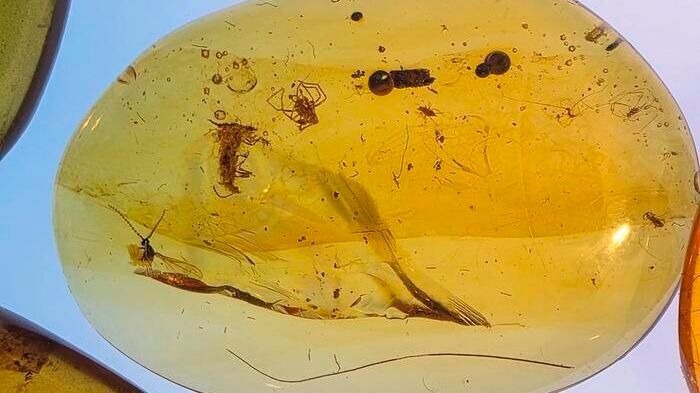
Case 6, photographed by Dr Jose de la Fuente. Amber now held in the KGJ Colección, Ciudad Real.
(Source: Dr Jose de la Fuente)
Tiny insects trapped in amber could tell us a great deal about their roles in past ecosystems: pollinators, parasites, predators, and prey. But how many of the insects preserved alongside each other reflect interactions during life, and how many are just unlucky coincidences? Scientists in Spain scrutinized six key samples which preserve now-extinct insects unusually well, to try to learn more about the ants that lived at the same time as the dinosaurs.
“Amber inclusions are representative of possible interactions between different organisms shaping the environment,” explained Dr Jose de la Fuente of the Institute for Game and Wildlife Research, Spain, lead author of the article in Frontiers in Ecology and Evolution. “The identification and morphological characterization of fossil ants in amber with other inclusions of insects provides a snapshot of life on Earth millions of years ago.”
Snapshots of the Past
The scientists looked at six different pieces of amber which include multiple different organisms of different species, a rare phenomenon called syninclusion. They chose these pieces of amber because they include ants, which are considered particularly important to ecosystems. The earliest ants, which were first found in the Upper Cretaceous, are known as Stem ants and didn’t leave modern descendants; all ants alive today evolved from Crown ants. Both species are found in the six pieces of amber studied by the scientists, as well as Hell ants, which evolved from Stem ants.
The study sample included four pieces of Cretaceous amber (around 99 million years old), one piece of Eocene amber (from approximately 56-34 million years ago), and one piece of Oligocene amber (from approximately 34-23 million years ago). The scientists used powerful microscopes to examine the amber, identify the different species found inside, and measure the distance between ants and other species.
In three of the six pieces of amber, the scientists found ants in close proximity to mites. In the first piece of amber, Case 1, the scientists found a Crown ant, wasp, and two mites so close to the ant that they may have been travelling on it. Similarly, Case 4 contained a Stem ant and a mite, about four millimeters apart. Case 5 also contained three different species of ant close to a mite and some termites, as well as poorly-preserved mosquitoes and a winged insect.
In Case 6 the scientists found a Stem ant alongside a probable parasitic wasp and a spider. The ant seems to have been feeding on something. It is resting against another insect inclusion, which could be a worm or a larva, but as there’s no indication that the two were interacting, the scientists think this was a coincidence.
Finally, Case 2 contained a Stem ant and a spider, while Case 3 contained a Hell ant, a snail, a millipede, and some unidentifiable insects.
Wrong Place, Wrong Time?
“The closest ant syninclusions are more likely to reflect behavior and interactions between these organisms,” said de la Fuente. “The proposed ant-mite interactions in Case 4 may reflect two possible scenarios. First, a commensal specialized temporal relationship where mites attach to ants for free ride dispersal to new habitats. Second, a parasitism when mites feed on the ant host during transport.”
Although pieces of amber that contain ants are rare, and pieces of amber that contain multiple species are rarer, there is some published evidence that points to interactions between mites and ants, sometimes mutually beneficial. Future research could help clarify this by using micro-CT scanning to look for attachment structures on mites which would have allowed them to clamber onboard ants for travel purposes. Similarly, the spider in Case 6 is a species which could camouflage itself as an ant and might have benefited from proximity to real ants.
The scientists say that smaller distances between insects in amber are more likely to reflect interactions during life, such as those between ants and mites. But they call for caution around inferred interactions: insects that aren’t in contact could just be insects that got stuck in the same resin.
“To improve the analysis of interactions between different organisms in fossil amber inclusions, future research should use advanced imaging techniques,” said de la Fuente. “Nevertheless, these results provide evidence of insect behavior and ecological habits.”
Date: 08.12.2025
Naturally, we always handle your personal data responsibly. Any personal data we receive from you is processed in accordance with applicable data protection legislation. For detailed information please see our privacy policy.
Consent to the use of data for promotional purposes
I hereby consent to Vogel Communications Group GmbH & Co. KG, Max-Planck-Str. 7-9, 97082 Würzburg including any affiliated companies according to §§ 15 et seq. AktG (hereafter: Vogel Communications Group) using my e-mail address to send editorial newsletters. A list of all affiliated companies can be found here
Newsletter content may include all products and services of any companies mentioned above, including for example specialist journals and books, events and fairs as well as event-related products and services, print and digital media offers and services such as additional (editorial) newsletters, raffles, lead campaigns, market research both online and offline, specialist webportals and e-learning offers. In case my personal telephone number has also been collected, it may be used for offers of aforementioned products, for services of the companies mentioned above, and market research purposes.
Additionally, my consent also includes the processing of my email address and telephone number for data matching for marketing purposes with select advertising partners such as LinkedIn, Google, and Meta. For this, Vogel Communications Group may transmit said data in hashed form to the advertising partners who then use said data to determine whether I am also a member of the mentioned advertising partner portals. Vogel Communications Group uses this feature for the purposes of re-targeting (up-selling, cross-selling, and customer loyalty), generating so-called look-alike audiences for acquisition of new customers, and as basis for exclusion for on-going advertising campaigns. Further information can be found in section “data matching for marketing purposes”.
In case I access protected data on Internet portals of Vogel Communications Group including any affiliated companies according to §§ 15 et seq. AktG, I need to provide further data in order to register for the access to such content. In return for this free access to editorial content, my data may be used in accordance with this consent for the purposes stated here. This does not apply to data matching for marketing purposes.
Right of revocation
I understand that I can revoke my consent at will. My revocation does not change the lawfulness of data processing that was conducted based on my consent leading up to my revocation. One option to declare my revocation is to use the contact form found at https://contact.vogel.de. In case I no longer wish to receive certain newsletters, I have subscribed to, I can also click on the unsubscribe link included at the end of a newsletter. Further information regarding my right of revocation and the implementation of it as well as the consequences of my revocation can be found in the data protection declaration, section editorial newsletter.
Original Article: Description of fossil amber with ant syninclusions; Frontiers in Ecology and Evolution; DOI:10.3389/fevo.2026.1724595




:quality(80)/p7i.vogel.de/wcms/aa/39/aa398d3e6667bdb43ad57abf38dc394c/0129347450v2.jpeg "An illustration shows a strand of engineered DNA passing through a nanoscale sensor, where its physical structure can be decoded as digital information. DNA nanostructures could one day serve as ultra-dense carriers of digital information and advance the field of data encryption. (Source: Jason Drees/ ASU)")
:quality(80)/p7i.vogel.de/wcms/06/a1/06a11f1d752afb35854aa9e1afb62e98/0129209625v2.jpeg "“Unsinkable\" metal tube made from chemically-etched aluminum floats in distilled water at the lab of University of Rochester professor Chunlei Guo. (Source: J. Adam Fenster / University of Rochester)")
:quality(80)/p7i.vogel.de/wcms/6d/df/6ddf023361ec7f8fbfb6c56521577960/0129056554v2.jpeg "The evolution of carburization (depicted by the spheres) under kinetic control (illustrated by the surface contours). The molecular beams represent gas evolution under synthesis conditions while the fiery sphere highlights the formation of the pure tungsten semi-carbide phase with additional molecular beams at the top to illustrate its catalytic performance. (Source: Sinhara M. H. D. Perera)")
:quality(80)/p7i.vogel.de/wcms/26/3d/263d97f8f2797267ecf2781b56882758/0129056451v1.jpeg "A study by the Complexity Science Hub finds that AI systems are already involved in nearly one-third of newly written software code, with rapid adoption in the United States and Europe and measurable productivity gains mainly for experienced developers. (Source: free licensed)")
:quality(80)/p7i.vogel.de/wcms/11/74/1174e5d4c8b07a64637dced8c9506b40/0129787561v2.jpeg "The Multicell Plus high-pressure reactor sets a new benchmark for operator safety, all-round accessibility and ease-of-use. (Source: Asynt)")
:quality(80)/p7i.vogel.de/wcms/ef/6e/ef6e96191183411973b77041fb6b1e16/0129785957v2.jpeg "Manufactured from high-quality crystal polystyrene - these new automation-ready plates are available in a choice of ANSI / SLAS standard (96-well and breakable 8-well strip) formats. (Source: Porvair Sciences)")
:quality(80)/p7i.vogel.de/wcms/ad/ca/adcaa20ef5ccaf7e3b325788b1e349c4/0129784872v2.jpeg "The high performance Degasi Flat Film in-line degasser. (Source: Biotech Fluidics)")
:quality(80)/p7i.vogel.de/wcms/22/d8/22d876eb82626568e404ebae75053986/0129781861v2.jpeg "Uniqsis has introduced a novel Tube-in-plate reactor that provides a cost-effective alternative to glass static mixer reactor blocks for highly exothermic or fast, mixing-dependent reactions. (Source: Uniqsis)")
:quality(80)/p7i.vogel.de/wcms/a3/52/a3527437a0f0bba5e58559a5c78e4f7a/0129797135v2.jpeg "PFAS have been used in a range of products, including non-stick cookware, cosmetics and fire extinguisher foam. (Source: free licensed)")
:quality(80)/p7i.vogel.de/wcms/05/94/0594c8529e29bf70b31c0f8db2e7a3cd/0129797089v1.jpeg "In related research, a team led by Princeton Professors Z. Jason Ren and Mark Zondlo studied emissions from U.S. wastewater plants.
(Source: Nathan Li/ Princeton University)")
:quality(80)/p7i.vogel.de/wcms/b5/05/b505af30c4c5d568073b613a9e9a1541/0129779931v2.jpeg "Researchers tested what factors improve or worsen the quality of sleep in mice. (Source: Pixabay)")
:quality(80)/p7i.vogel.de/wcms/8c/39/8c392d01443d1dd972c8c1b498514199/0129776466v2.jpeg "Individuals exposed as children to indoor air pollution from solid fuels performed significantly worse on cognitive tests in adulthood. (Source: Pixabay)")
:quality(80)/p7i.vogel.de/wcms/84/2c/842c7c1678ceeec7147ea3a36e238e75/0129356324v2.jpeg "Kaust and Nadec have signed a MOU that establishes a framework for long-term cooperation across agricultural research, technology development, and professional training. (Source: Kaust )")
:quality(80)/p7i.vogel.de/wcms/d1/3c/d13c2ad34af600dbd360c0bb0990b922/0129045715v2.jpeg "Replacing animal products with plant-based foods helps reduce the risk of heart disease and type 2 diabetes, finds a new review by the Physicians Committee for Responsible Medicine. (Source: Pixabay)")
:quality(80)/p7i.vogel.de/wcms/e1/b3/e1b3e26d03101ba93b76b304da150c9a/0129025388v2.jpeg "The research reanalyzed data from a seminal clinical trial, led by US National Institutes of Health veteran Dr Kevin Hall, which first exposed how eating exclusively UPFs results in excessive calorie consumption and weight gain. (Source: Pixabay)")
:quality(80)/p7i.vogel.de/wcms/75/db/75db8afe45607bee750df705e22b60e9/0128938816v1.jpeg "A new academic review suggests that bamboo shoots could offer significant health benefits, including improved blood sugar control, gut health and antioxidant activity. (Source: free licensed)")
:quality(80)/p7i.vogel.de/wcms/e6/49/e649f8e8a4b990611fd1c1d8a1aa50a5/0129797212v2.jpeg "Case 6, photographed by Dr Jose de la Fuente. Amber now held in the KGJ Colección, Ciudad Real. (Source: Dr Jose de la Fuente)")
:quality(80)/p7i.vogel.de/wcms/2b/1b/2b1b4dcdea620784c5f7beb1a865f618/0129797180v1.jpeg "Graphical illustration of how this research is envisioned in humans (Source: Houston Methodist)")
:quality(80)/p7i.vogel.de/wcms/a4/e8/a4e8c7b44b600ad8609fcfad11088b72/0129797160v1.jpeg "The sleep biology of adolescents is geared towards falling asleep late. With school starting early these days, chronic sleep deprivation can occur. (Source: free licensed)")
:quality(80)/p7i.vogel.de/wcms/6e/b4/6eb490e9ca40cb42034b3052a874e46e/0129778274v2.jpeg "The researchers tested a specific class of these PLPs, called Hydracs (Hybrid Degrading Copolymers), on two particularly problematic proteins: MYC and KRAS. (Source: Nathan Gianneschi/Northwestern University)")
:quality(80)/images.vogel.de/vogelonline/bdb/1710600/1710675/original.jpg "Discover how to set yourself up for success when performing balance-based density determination of solids such as jewelry and precious metals. (Mettler Toledo)")
:quality(80)/images.vogel.de/vogelonline/bdb/1682500/1682579/original.jpg "The new XPR Analytical balance redesigned to meet the needs of laboratory technicians of working fast and lean. (Mettler Toledo)")
:quality(80)/images.vogel.de/vogelonline/bdb/1677000/1677080/original.jpg "Enhance your weighing accuracy, comfort and productivity with the redesigned XPR Analytical balance. (Mettler Toledo)")
:quality(80)/p7i.vogel.de/wcms/6e/29/6e298a9e10cfb7b16d2aa475d225364f/0120274755v1.jpeg "Left: Amber with Beorn and Aerobius; Right: Artistic reconstruction of the two fossil specimens. (Source: Marc Mapalo (amber); Franz Anthony (artistic reconstruction))")
:quality(80)/p7i.vogel.de/wcms/34/a4/34a44fab2ba6af4b5f7cb8c3ecfc6362/0129207768v1.jpeg "AI generated image of the New Zealand cave (Source: P Scofield, Canterbury Museum)")
:quality(80)/p7i.vogel.de/wcms/12/28/12281fde8d2188ce7a7f0230b0d58d03/0123746004v3.jpeg "A cichlid group consisting of the breeding pair and several brood care helpers of different sizes. Social cichlids divide various tasks among group members but do not pursue strictly specialized tasks. (Source: © Dario Josi)")
:quality(80)/p7i.vogel.de/wcms/34/a4/34a44fab2ba6af4b5f7cb8c3ecfc6362/0129207768v1.jpeg "AI generated image of the New Zealand cave (Source: P Scofield, Canterbury Museum)")