EvolutionAnts Perfected Agriculture 66 Million Years Ago, Long Before Humans
Source:
Smithsonian
4 min Reading Time
Long before humans mastered agriculture, ants were already farming fungi. New research reveals that ants began cultivating fungi 66 million years ago after a mass extinction event created ideal conditions for fungi to thrive.
A lower-fungus-farming worker of the rare fungus-farming ant species Mycetophylax asper, collected in Santa Catarina, Brazil, in 2014, on its fungus garden.
(Source: Don Parsons)
When humans began farming crops thousands of years ago, agriculture had already been around for millions of years. In fact, several animal lineages have been growing their own food since long before humans evolved as a species.
According to a new study, colonies of ants began farming fungi when an asteroid struck Earth 66 million years ago. This impact caused a global mass extinction but also created ideal conditions for fungi to thrive. Innovative ants began cultivating the fungi, creating an evolutionary partnership that became even more tightly intertwined 27 million years ago and continues to this day.
Gallery
In a paper published in the journal Science, scientists at the Smithsonian’s National Museum of Natural History analyzed genetic data from hundreds of species of fungi and ants to craft detailed evolutionary trees. Comparing these trees allowed the researchers to create an evolutionary timeline of ant agriculture and pinpoint when ants first began cultivating fungi.
“Ants have been practicing agriculture and fungus farming for much longer than humans have existed,” said entomologist Ted Schultz, the museum’s curator of ants and the lead author of the new paper. “We could probably learn something from the agricultural success of these ants over the past 66 million years.”
Nearly 250 different species of ants in the Americas and Caribbean farm fungi. Researchers organize these ants into four agricultural systems based on their cultivation strategies. Leafcutter ants are among those that practice the most advanced strategy, known as higher agriculture. These ants harvest bits of fresh vegetation to provide sustenance for their fungi, which in turn grow food for the ants called gongylidia. This food helps fuel complex colonies of leaf cutter ants that can number in the millions.
Schultz has spent 35 years studying the evolutionary relationship between ants and fungi. He has conducted more than 30 expeditions to locales in Central and South America to observe this interaction in the wild and has reared colonies of leafcutter and other fungus-farming ants in his lab at the museum. Over the years, Schultz and colleagues have collected thousands of genetic samples of ants and fungi from throughout the tropics.
This stockpile of samples was crucial to the new paper. “To really detect patterns and reconstruct how this association has evolved through time, you need lots of samples of ants and their fungal cultivars,” Schultz said.
The team used the samples to sequence genetic data for 475 different species of fungi (288 of which are cultivated by ants) and 276 different species of ants (208 of which cultivate fungi) — the largest genetic dataset of fungus-farming ants ever assembled. This allowed the researchers to create evolutionary trees of the two groups. Comparing wild fungal species with their cultivated relatives helped the researchers determine when ants began utilizing certain fungi.
From Catastrophe to Cooperation
The data revealed that ants and fungi have been intertwined for 66 million years. This is around the time when an asteroid struck Earth at the end of the Cretaceous period. This cataclysmic collision filled the atmosphere with dust and debris, which blocked out the sun and prevented photosynthesis for years. The resulting mass extinction wiped out roughly half of all plant species on Earth at the time.
However, this catastrophe was a boon for fungi. These organisms proliferated as they consumed the plentiful dead plant material littering the ground.
“Extinction events can be huge disasters for most organisms, but it can actually be positive for others,” Schultz said. “At the end of Cretaceous, dinosaurs did not do very well, but fungi experienced a heyday.”
Many of the fungi that proliferated during this period likely feasted on decaying leaf litter, which brought them in close contact with ants. These insects harnessed the plentiful fungi for food and continued to rely on the hardy fungi as life rebounded from the extinction event.
The new work also revealed that it took nearly another 40 million years for ants to then develop higher agriculture. The researchers were able to trace the origin of this advanced practice back to around 27 million years ago. At this time, a rapidly cooling climate transformed environments around the globe. In South America, drier habitats like woody savannas and grasslands fractured large swaths of wet, tropical forests. When ants took fungi out of the wet forests and into drier areas, they isolated the fungi from their wild ancestral populations. The isolated fungi became completely reliant on ants to survive in the arid conditions, setting the course for the higher agriculture system practiced by leafcutter ants today.
Date: 08.12.2025
Naturally, we always handle your personal data responsibly. Any personal data we receive from you is processed in accordance with applicable data protection legislation. For detailed information please see our privacy policy.
Consent to the use of data for promotional purposes
I hereby consent to Vogel Communications Group GmbH & Co. KG, Max-Planck-Str. 7-9, 97082 Würzburg including any affiliated companies according to §§ 15 et seq. AktG (hereafter: Vogel Communications Group) using my e-mail address to send editorial newsletters. A list of all affiliated companies can be found here
Newsletter content may include all products and services of any companies mentioned above, including for example specialist journals and books, events and fairs as well as event-related products and services, print and digital media offers and services such as additional (editorial) newsletters, raffles, lead campaigns, market research both online and offline, specialist webportals and e-learning offers. In case my personal telephone number has also been collected, it may be used for offers of aforementioned products, for services of the companies mentioned above, and market research purposes.
Additionally, my consent also includes the processing of my email address and telephone number for data matching for marketing purposes with select advertising partners such as LinkedIn, Google, and Meta. For this, Vogel Communications Group may transmit said data in hashed form to the advertising partners who then use said data to determine whether I am also a member of the mentioned advertising partner portals. Vogel Communications Group uses this feature for the purposes of re-targeting (up-selling, cross-selling, and customer loyalty), generating so-called look-alike audiences for acquisition of new customers, and as basis for exclusion for on-going advertising campaigns. Further information can be found in section “data matching for marketing purposes”.
In case I access protected data on Internet portals of Vogel Communications Group including any affiliated companies according to §§ 15 et seq. AktG, I need to provide further data in order to register for the access to such content. In return for this free access to editorial content, my data may be used in accordance with this consent for the purposes stated here. This does not apply to data matching for marketing purposes.
Right of revocation
I understand that I can revoke my consent at will. My revocation does not change the lawfulness of data processing that was conducted based on my consent leading up to my revocation. One option to declare my revocation is to use the contact form found at https://contact.vogel.de. In case I no longer wish to receive certain newsletters, I have subscribed to, I can also click on the unsubscribe link included at the end of a newsletter. Further information regarding my right of revocation and the implementation of it as well as the consequences of my revocation can be found in the data protection declaration, section editorial newsletter.
“The ants domesticated these fungi in the same way that humans domesticated crops,” Schultz said. “What’s extraordinary is now we can date when the higher ants originally cultivated the higher fungi.”
Original Article: The coevolution of fungus-ant agriculture; Science; DOI:10.1126/science.adn7179




:quality(80)/p7i.vogel.de/wcms/92/ad/92adbafb37924cea35ea3cf05b7a23e5/0130206318v2.jpeg "The world’s first fully functioning proof-of-concept quantum battery
(Source: Csiro)")
:quality(80)/p7i.vogel.de/wcms/9f/8b/9f8bc2b8491d7a514ca154e9588a07b7/0130205846v1.jpeg "The researchers’ new material, based on mineralised sawdust, is an excellent fire retardant. (Source: Dan Vivas Glaser / from Kürsteiner R et al. Chem Circularity 2026)")
:quality(80)/p7i.vogel.de/wcms/fd/73/fd73fcb3ceda89d1419de1083fcab7b4/0130081520v2.jpeg "The fingers at the heart of this technology were inspired by the fin-ray effect — a design principle derived from the natural structure of fish fins. (Source: University of Texas at Austin )")
:quality(80)/p7i.vogel.de/wcms/fe/64/fe649767c802d53ac63ee2c2a40b7e0d/0130060830v2.jpeg "Sample tube with light-active substance (Source: Elvira Eberhardt / Ulm University)")
:quality(80)/p7i.vogel.de/wcms/8f/b9/8fb98a958e4afe679865fbe52a473680/0129940982v2.jpeg "pH measurement in various nanoparticles using the Nine-Focus meter ensures precise stability and performance control. (Source: Mettler Toledo)")
:quality(80)/p7i.vogel.de/wcms/11/74/1174e5d4c8b07a64637dced8c9506b40/0129787561v2.jpeg "The Multicell Plus high-pressure reactor sets a new benchmark for operator safety, all-round accessibility and ease-of-use. (Source: Asynt)")
:quality(80)/p7i.vogel.de/wcms/ef/6e/ef6e96191183411973b77041fb6b1e16/0129785957v2.jpeg "Manufactured from high-quality crystal polystyrene - these new automation-ready plates are available in a choice of ANSI / SLAS standard (96-well and breakable 8-well strip) formats. (Source: Porvair Sciences)")
:quality(80)/p7i.vogel.de/wcms/ad/ca/adcaa20ef5ccaf7e3b325788b1e349c4/0129784872v2.jpeg "The high performance Degasi Flat Film in-line degasser. (Source: Biotech Fluidics)")
:quality(80)/p7i.vogel.de/wcms/e9/9c/e99cb19231197af70c489cb4acc2ead0/0130293444v2.jpeg "A new global study, led by researchers at Kaust in Saudi Arabia, shows that forests are most effective for climate regulation when conserved or restored in their natural or native locations. (Source: Kaust )")
:quality(80)/p7i.vogel.de/wcms/af/40/af40b535eb65c287fbd22ed5483d1d0e/0130206243v2.jpeg "The researchers dug soil pits in order to measure the carbon storage in soil
(Source: Johanna Asch)")
:quality(80)/p7i.vogel.de/wcms/2d/45/2d45aba62f5042baa00f7fd4fa629839/0130036533v2.jpeg "The population of Pune, India, is expected to reach 11 million by 2050. (Source: free licensed)")
:quality(80)/p7i.vogel.de/wcms/52/f8/52f8d5521fdab07ed0a865ec0d8919fd/0130009438v2.jpeg "Drylands support around half of global livestock production and sustain the livelihoods of close to a billion people, while also underpinning soil stability and carbon storage. (Source: Kaust )")
:quality(80)/p7i.vogel.de/wcms/6f/ba/6fba92196d0cbb1467334f8a2ecc520a/0130203021v2.jpeg "Low to moderate wine consumption shows lower risk compared with spirits, beer and cider (Source: free licensed)")
:quality(80)/p7i.vogel.de/wcms/a9/37/a9376f1d9a893570023d9aa97c085bc5/0129927485v2.jpeg "Examples of foods high in PUFAs include fatty fish and soybeans, while MUFAs include olive oil and avocadoes. (Source: free licensed)")
:quality(80)/p7i.vogel.de/wcms/ea/88/ea88ef8810e21cdd9bb852c70f385ba1/0129797385v2.jpeg "A team of NUS food scientists consisting of Assoc Prof Liu Shao Quan (centre), Dr Lu Yuyun (right) and Ms Geng Chenhan (left) pioneered a co-fermentation method that improves both the nutrient and flavor profile of kombu. (Source: NUS)")
:quality(80)/p7i.vogel.de/wcms/84/2c/842c7c1678ceeec7147ea3a36e238e75/0129356324v2.jpeg "Kaust and Nadec have signed a MOU that establishes a framework for long-term cooperation across agricultural research, technology development, and professional training. (Source: Kaust )")
:quality(80)/p7i.vogel.de/wcms/6e/b9/6eb95805568aa78dc2ed57f829cf33d4/0130300421v2.jpeg "A 10-minute digital program co-developed by a University of Texas psychologist significantly reduced symptoms of depression four weeks after use, according to results from one of the largest randomized controlled trials of single-session mental health interventions. (Source: University of Texas at Austin )")
:quality(80)/p7i.vogel.de/wcms/6f/e9/6fe9d920eca2c0b3bdeb55cbe9f01908/0130299237v2.jpeg "Study authors Jason Miska and Leah Billingham reading out enzymatic activity of microglia in cell cultures. (Source: Northwestern University.)")
:quality(80)/p7i.vogel.de/wcms/c4/54/c454661a9dd459cf7c5b632f79829358/0130284530v2.jpeg "The study shows that AI can be used to assess the build-up of calcium deposits in the arteries of the breast from the standard X-ray mammography scans that are currently used in routine breast cancer screening. (Source: ESC)")
:quality(80)/p7i.vogel.de/wcms/67/9b/679b140c164dbd7c4fe9eda4da91329b/0130281406v3.jpeg "This is the highest resolution molecular structure ever constructed of a key protein complex on the surface of the Andes virus, called the Gn-Gc tetramer, that enables it to infect cells. (Source: University of Texas at Austin)")
:quality(80)/images.vogel.de/vogelonline/bdb/1710600/1710675/original.jpg "Discover how to set yourself up for success when performing balance-based density determination of solids such as jewelry and precious metals. (Mettler Toledo)")
:quality(80)/images.vogel.de/vogelonline/bdb/1682500/1682579/original.jpg "The new XPR Analytical balance redesigned to meet the needs of laboratory technicians of working fast and lean. (Mettler Toledo)")
:quality(80)/images.vogel.de/vogelonline/bdb/1677000/1677080/original.jpg "Enhance your weighing accuracy, comfort and productivity with the redesigned XPR Analytical balance. (Mettler Toledo)")
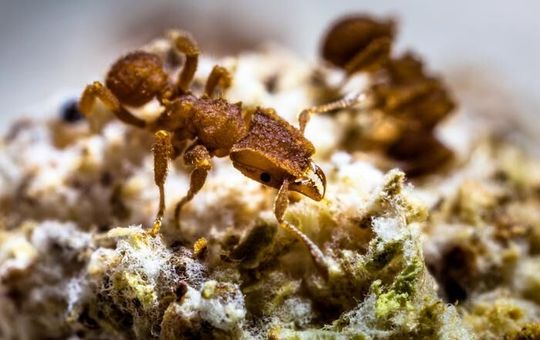
:quality(80)/p7i.vogel.de/wcms/83/86/838685762773196a83d5d86afabbf550/0121028267v2.jpeg "A lower-fungus-farming worker of the rare fungus-farming ant species Mycetophylax asper, collected in Santa Catarina, Brazil, in 2014, on its fungus garden.(Source: Don Parsons)")
:quality(80)/p7i.vogel.de/wcms/70/22/7022cc68cfe8764a3482fe41cb210abb/0121028264v3.jpeg "The queen and workers of the leaf-cutting fungus-farming ant species Atta cephalotes, collected in Panama, on their higher-agriculture fungus garden.(Source: Karolyn Darrow)")
:quality(80)/p7i.vogel.de/wcms/d7/6b/d76b2f5b45a563eba793d825fa391679/0121028265v2.jpeg "Entomologist Ted Schultz, the curator of ants at the Smithsonian’s National Museum of Natural History and the lead author of the new paper, on an ant-collecting expedition to the Acarai Mountains of southern Guyana in October 2006.(Source: Jeffrey Sosa-Calvo)")
:quality(80)/p7i.vogel.de/wcms/98/58/9858116669c82a6e10cb2258493ea3c8/0126916386v2.jpeg "Cultivated landscape structured at a small-scale, featuring rows of trees, grass strips and fallow strips along the fence posts. (Source: Arne Wenzel)")
:quality(80)/p7i.vogel.de/wcms/e6/49/e649f8e8a4b990611fd1c1d8a1aa50a5/0129797212v2.jpeg "Case 6, photographed by Dr Jose de la Fuente. Amber now held in the KGJ Colección, Ciudad Real. (Source: Dr Jose de la Fuente)")