In the post-emergency phase of the Covid-19 pandemic, scientists are focusing on real-time surveillance methods for indoor environments to detect viruses. At the forefront of these efforts, researchers at Washington University in St. Louis have harnessed the power of cutting-edge aerosol sampling and ultrasensitive biosensing technology.
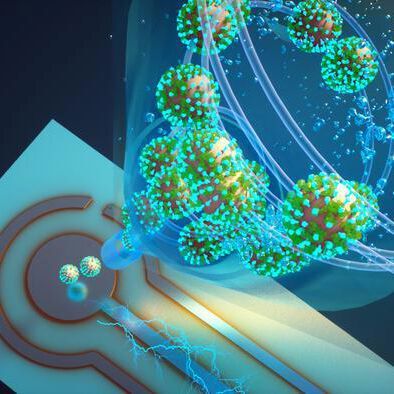
A team of researchers at the McKelvey School of Engineering and the School of Medicine has developed a proof-of-concept air quality monitor that can detect live SARS-CoV-2 virus in indoor environments. The monitor uses a biosensor made with nanobodies that is integrated into an air sampler that operates based on the wet cyclone technology.
(Source: Joseph Puthussery)
Now that the emergency phase of the Covid-19 pandemic has ended, scientists are looking at ways to surveil indoor environments in real time for viruses. By combining recent advances in aerosol sampling technology and an ultrasensitive biosensing technique, researchers at Washington University in St. Louis have created a real-time monitor that can detect any of the SARS-CoV-2 virus variants in a room in about 5 minutes.
The inexpensive, proof-of-concept device could be used in hospitals and health care facilities, schools and public places to help detect CoV-2 and potentially monitor for other respiratory virus aerosols, such as influenza and respiratory syncytial virus (RSV). Results of their work on the monitor, which they say is the most sensitive detector available, are published July 10 in Nature Communications.
The interdisciplinary team of researchers from the McKelvey School of Engineering and the School of Medicine consists of Rajan Chakrabarty, the Harold D. Jolley Career Development Associate Professor of energy, environmental & chemical engineering in McKelvey Engineering; Joseph Puthussery, a postdoctoral research associate in Chakrabarty’s lab; John Cirrito, a professor of neurology at the School of Medicine; and Carla Yuede, an associate professor of psychiatry at the School of Medicine.
“There is nothing at the moment that tells us how safe a room is,” Cirrito said. “If you are in a room with 100 people, you don’t want to find out five days later whether you could be sick or not. The idea with this device is that you can know essentially in real time, or every five minutes, if there is a live virus.”
Cirrito and Yuede had previously developed a micro-immunoelectrode (MIE) biosensor that detects amyloid beta as a biomarker for Alzheimer’s disease and wondered if it could be converted into a detector for SARS-CoV-2. They reached out to Chakrabarty, who assembled a team that included Puthussery, who had expertise in building real-time instruments to measure the toxicity of air.
To convert the biosensor from detecting amyloid beta to coronavirus, the researchers exchanged the antibody that recognizes amyloid beta for a nanobody from llamas that recognizes the spike protein from the SARS-CoV-2 virus. David Brody, MD, PhD, a former faculty member in the Department of Neurology at the School of Medicine and an author on the paper, developed the nanobody in his lab at the National Institutes of Health (NIH). The nanobody is small, easy to reproduce and modify and inexpensive to make, the researchers said.
“The nanobody-based electrochemical approach is faster at detecting the virus because it doesn’t need a reagent or a lot of processing steps,” Yuede said. “SARS-CoV-2 binds to the nanobodies on the surface, and we can induce oxidation of tyrosines on the surface of the virus using a technique called square wave voltammetry to get a measurement of the amount of virus in the sample.”
Chakrabarty and Puthussery integrated the biosensor into an air sampler that operates based on the wet cyclone technology. Air enters the sampler at very high velocities and gets mixed centrifugally with the fluid that lines the walls of the sampler to create a surface vortex, thereby trapping the virus aerosols. The wet cyclone sampler has an automated pump that collects the fluid and sends it to the biosensor for seamless detection of the virus using electrochemistry.
“The challenge with airborne aerosol detectors is that the level of virus in the indoor air is so diluted that it even pushes toward the limit of detection of polymerase chain reaction (PCR) and is like finding a needle in a haystack,” Chakrabarty said. “The high virus recovery by the wet cyclone can be attributed to its extremely high flow rate, which allows it to sample a larger volume of air over a 5-minute sample collection compared with commercially available samplers.”
Most commercial bioaerosol samplers operate at relatively low flow rates, Puthussery said, while the team’s monitor has a flow rate of about 1,000 liters per minute, making it one of the highest flow-rate devices available. It is also compact at about 1 foot wide and 10 inches tall and lights up when a virus is detected, alerting administrators to increase airflow or circulation in the room.
Date: 08.12.2025
Naturally, we always handle your personal data responsibly. Any personal data we receive from you is processed in accordance with applicable data protection legislation. For detailed information please see our privacy policy.
Consent to the use of data for promotional purposes
I hereby consent to Vogel Communications Group GmbH & Co. KG, Max-Planck-Str. 7-9, 97082 Würzburg including any affiliated companies according to §§ 15 et seq. AktG (hereafter: Vogel Communications Group) using my e-mail address to send editorial newsletters. A list of all affiliated companies can be found here
Newsletter content may include all products and services of any companies mentioned above, including for example specialist journals and books, events and fairs as well as event-related products and services, print and digital media offers and services such as additional (editorial) newsletters, raffles, lead campaigns, market research both online and offline, specialist webportals and e-learning offers. In case my personal telephone number has also been collected, it may be used for offers of aforementioned products, for services of the companies mentioned above, and market research purposes.
Additionally, my consent also includes the processing of my email address and telephone number for data matching for marketing purposes with select advertising partners such as LinkedIn, Google, and Meta. For this, Vogel Communications Group may transmit said data in hashed form to the advertising partners who then use said data to determine whether I am also a member of the mentioned advertising partner portals. Vogel Communications Group uses this feature for the purposes of re-targeting (up-selling, cross-selling, and customer loyalty), generating so-called look-alike audiences for acquisition of new customers, and as basis for exclusion for on-going advertising campaigns. Further information can be found in section “data matching for marketing purposes”.
In case I access protected data on Internet portals of Vogel Communications Group including any affiliated companies according to §§ 15 et seq. AktG, I need to provide further data in order to register for the access to such content. In return for this free access to editorial content, my data may be used in accordance with this consent for the purposes stated here. This does not apply to data matching for marketing purposes.
Right of revocation
I understand that I can revoke my consent at will. My revocation does not change the lawfulness of data processing that was conducted based on my consent leading up to my revocation. One option to declare my revocation is to use the contact form found at https://contact.vogel.de. In case I no longer wish to receive certain newsletters, I have subscribed to, I can also click on the unsubscribe link included at the end of a newsletter. Further information regarding my right of revocation and the implementation of it as well as the consequences of my revocation can be found in the data protection declaration, section editorial newsletter.
The team tested the monitor in the apartments of two Covid-positive patients. The real-time PCR results of air samples from the bedrooms were compared with air samples collected from a virus-free control room. The devices detected RNA of the virus in the air samples from the bedrooms but did not detect any in the control air samples.
In laboratory experiments that aerosolized SARS-CoV-2 into a room-sized chamber, the wet cyclone and biosensor were able to detect varying levels of airborne virus concentrations after only a few minutes of sampling.
“We are starting with SARS-CoV-2, but there are plans to also measure influenza, RSV, rhinovirus and other top pathogens that routinely infect people,” Cirrito said. “In a hospital setting, the monitor could be used to measure for staph or strep, which cause all kinds of complications for patients. This could really have a major impact on people’s health.”
The team is working to commercialize the air quality monitor.




:quality(80)/p7i.vogel.de/wcms/45/87/458714daead8bb6b83d5305ff764e8c1/0130386255v1.jpeg "Examples of drawings from each category, with the scores they received from humans, independent AI and the human-guided AI. (Source: Advanced Science)")
:quality(80)/p7i.vogel.de/wcms/66/7c/667c242f45cc06eb5bee090c7723ba0b/0130384415v2.jpeg "Inspired by arm-wrestling, the NUS team built a self-training platform (left) where two rings of muscle tissues continuously and autonomously pull against each other. Ostrabot (right), made from a single trained ring of muscle and two flexible tails, swims 3 times faster than counterparts with conventionally cultured muscle. (Source: National University of Singapore)")
:quality(80)/p7i.vogel.de/wcms/92/ad/92adbafb37924cea35ea3cf05b7a23e5/0130206318v2.jpeg "The world’s first fully functioning proof-of-concept quantum battery
(Source: Csiro)")
:quality(80)/p7i.vogel.de/wcms/9f/8b/9f8bc2b8491d7a514ca154e9588a07b7/0130205846v1.jpeg "The researchers’ new material, based on mineralised sawdust, is an excellent fire retardant. (Source: Dan Vivas Glaser / from Kürsteiner R et al. Chem Circularity 2026)")
:quality(80)/p7i.vogel.de/wcms/8f/b9/8fb98a958e4afe679865fbe52a473680/0129940982v2.jpeg "pH measurement in various nanoparticles using the Nine-Focus meter ensures precise stability and performance control. (Source: Mettler Toledo)")
:quality(80)/p7i.vogel.de/wcms/11/74/1174e5d4c8b07a64637dced8c9506b40/0129787561v2.jpeg "The Multicell Plus high-pressure reactor sets a new benchmark for operator safety, all-round accessibility and ease-of-use. (Source: Asynt)")
:quality(80)/p7i.vogel.de/wcms/ef/6e/ef6e96191183411973b77041fb6b1e16/0129785957v2.jpeg "Manufactured from high-quality crystal polystyrene - these new automation-ready plates are available in a choice of ANSI / SLAS standard (96-well and breakable 8-well strip) formats. (Source: Porvair Sciences)")
:quality(80)/p7i.vogel.de/wcms/ad/ca/adcaa20ef5ccaf7e3b325788b1e349c4/0129784872v2.jpeg "The high performance Degasi Flat Film in-line degasser. (Source: Biotech Fluidics)")
:quality(80)/p7i.vogel.de/wcms/5d/bb/5dbb962b09bae1c078a8ff996666bc8e/0130386229v2.jpeg "This image created using Gemini Pro, depicts an activated carbon fiber functionalized with amine groups (–NH2) at adjacent positions. This arrangement improves the energy efficacy of key interactions, enabling the desorption of captured carbon dioxide at lower temperatures. (Source: Gemini / Yasuhiro Yamada/ Chiba University / KI-generiert)")
:quality(80)/p7i.vogel.de/wcms/21/9b/219b000051ab1ea14ab5f92e4fd0f9bb/0130384937v2.jpeg "Deforestation in the Appalachian mountains. (Source: Alex Diaz on Unsplash)")
:quality(80)/p7i.vogel.de/wcms/e9/9c/e99cb19231197af70c489cb4acc2ead0/0130293444v2.jpeg "A new global study, led by researchers at Kaust in Saudi Arabia, shows that forests are most effective for climate regulation when conserved or restored in their natural or native locations. (Source: Kaust )")
:quality(80)/p7i.vogel.de/wcms/af/40/af40b535eb65c287fbd22ed5483d1d0e/0130206243v2.jpeg "The researchers dug soil pits in order to measure the carbon storage in soil
(Source: Johanna Asch)")
:quality(80)/p7i.vogel.de/wcms/2a/07/2a0737995810d504b318f8a0f9ac2c3d/0130386209v1.jpeg "Simple, repeatable eating habits may help people stick to diets, see better results, study says (Source: free licensed)")
:quality(80)/p7i.vogel.de/wcms/6f/ba/6fba92196d0cbb1467334f8a2ecc520a/0130203021v2.jpeg "Low to moderate wine consumption shows lower risk compared with spirits, beer and cider (Source: free licensed)")
:quality(80)/p7i.vogel.de/wcms/a9/37/a9376f1d9a893570023d9aa97c085bc5/0129927485v2.jpeg "Examples of foods high in PUFAs include fatty fish and soybeans, while MUFAs include olive oil and avocadoes. (Source: free licensed)")
:quality(80)/p7i.vogel.de/wcms/ea/88/ea88ef8810e21cdd9bb852c70f385ba1/0129797385v2.jpeg "A team of NUS food scientists consisting of Assoc Prof Liu Shao Quan (centre), Dr Lu Yuyun (right) and Ms Geng Chenhan (left) pioneered a co-fermentation method that improves both the nutrient and flavor profile of kombu. (Source: NUS)")
:quality(80)/p7i.vogel.de/wcms/40/c0/40c0c09c2bad7b925a069edbbac90621/0130385557v1.jpeg "When a stroke damages brain tissue (red) along an important movement pathway (yellow), the injured side of the brain may show faster aging (red), while parts of the opposite side may appear relatively “younger” (blue) as the brain tries to compensate. This pattern is linked to more severe movement problems and less recovery.
(Bild: Stevens INI)")
:quality(80)/p7i.vogel.de/wcms/32/14/3214c28a03f71ad067c5f27e5bd6772b/0130386218v1.jpeg "Antimicrobial-resistant Salmonella poses severe challenges to global food safety and public health. (Source: free licensed)")
:quality(80)/p7i.vogel.de/wcms/30/2e/302e195d532fc9aced73406b07642b57/0130384900v2.jpeg "Sleeping for 11 minutes more, doing an additional 4.5 minutes of moderate-to-vigorous physical activity, and eating additional quarter of a cup of vegetables were associated with a 10 % reduction in major cardiovascular events. (Source: Pixabay)")
:quality(80)/p7i.vogel.de/wcms/47/41/4741ee3c589369a09ab0e3a26b7143f0/0130384858v2.jpeg "A female, Aedes aegypti mosquito, after taking her blood meal. (Source: Lauren Bishop CDC)")
:quality(80)/images.vogel.de/vogelonline/bdb/1710600/1710675/original.jpg "Discover how to set yourself up for success when performing balance-based density determination of solids such as jewelry and precious metals. (Mettler Toledo)")
:quality(80)/images.vogel.de/vogelonline/bdb/1682500/1682579/original.jpg "The new XPR Analytical balance redesigned to meet the needs of laboratory technicians of working fast and lean. (Mettler Toledo)")
:quality(80)/images.vogel.de/vogelonline/bdb/1677000/1677080/original.jpg "Enhance your weighing accuracy, comfort and productivity with the redesigned XPR Analytical balance. (Mettler Toledo)")
:quality(80)/p7i.vogel.de/wcms/d8/72/d872aadfaed7ae203fb348559cb6e66d/0124882971v1.jpeg "Researchers at Institute of Science Tokyo have engineered transparent hydrogen boride nanosheet coatings that deactivate SARS-CoV-2, influenza, bacteria, and fungi to undetectable levels within ten minutes — without light. By denaturing microbial proteins in the dark while remaining optically clear, these coatings promise versatile, metal-free surface protection for everyday infection control.
(Source: Institute of Science Tokyo)")
:quality(80)/p7i.vogel.de/wcms/31/a6/31a674691a95175dbffcdd3a5c12f8e5/0125458002v2.jpeg "Assoc Prof Benjamin Tee (right), Liu Mengmeng (left), Ms Yu Kelu (centre) and their team from NUS have developed the Resurf sensor – an ultrafast, stretchable, self-healing and recyclable sensor for real-time water quality monitoring – and tested it on a pufferfish-like soft robot. (Source: NUS)")