In a new study, researchers made use of artificial intelligence (AI) and found out that fish habitats are negatively affected by human activities. Based on this study, various measures to protect biodiversity and potential fish habitats will be developed.
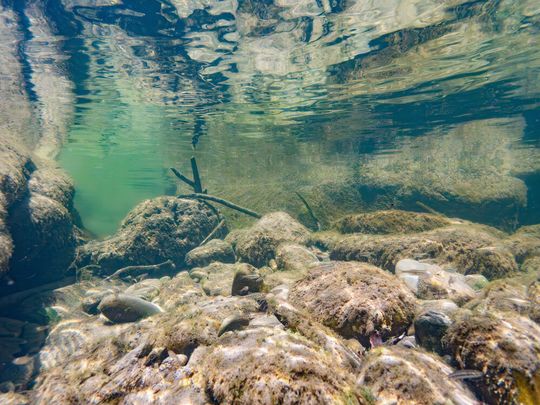
Life under water is often overlooked, here a school of minnows find refuge at the shore of the Sense where the river is less powerful.
Bern/Switzerland – A fundamental challenge exists in ecology when trying to understand why a species lives in some locations but not others. Natural factors such as the climate and the availability of food are decisive in determining where each species can best live. Yet, research often overlooks how humans alter the available areas within this optimal habitat. Freshwater ecosystems are some of the worst impacted by human activities. As such, it is crucial to understand where humans are negatively impacting freshwater organisms within its optimal habitat.
In a new study published in Nature Communications, researchers from the Department of Aquatic Ecology and Evolution at the Institute of Ecology and Evolution at the University of Bern, in collaboration with Eawag, show that almost 90 % of potential freshwater fish habitats in Switzerland are negatively impacted by human activities. These include unnatural features in watercourses such as artificial banks and barriers that hinder the migration of species in rivers and lakes. “The research highlights the importance of knowing how much a species' habitat is affected by human activities in order to identify the factors that pose the greatest threat to populations,” says lead author Conor Waldock from the Institute of Ecology and Evolution at the University of Bern.
Uncovering hidden life using artificial intelligence
To identify the areas of fish species' natural habitat where humans have the greatest impact on fish populations, the researchers compiled data on the populations of nine fish species throughout the Aare-Rhine catchment. They then linked this data with numerous environmental factors, representing both natural and human-caused influences. To find correlations between the environmental factors and the occurrence of fish populations, the researchers used a research approach based on machine learning. However, this traditional approach could only show where species are most likely to occur, but not what factors enable or prevent their occurrence there. “Therefore, in a next step, we applied 'Explainable Artificial Intelligence' which showed for 15,000 river catchments in Switzerland which environmental factors determined whether the respective location is good or bad for the individual species," explains Waldock.
Potential habitats for freshwater fish are large but under threat
The research results show that 40 % of all river basins would be suitable habitat for the endangered Spirlin (Alburnoides bipunctatus) studied in the study, due to the natural conditions for survival, growth and reproduction of the species. However, most of this suitable habitat is affected by human activities that have a negative impact on the species, as the study shows. “These results also provide new insights into the possible causes of the decline of the Spirlin," says Waldock. Similar results were found for the other fish species studied with an average of around 90 % of potential habitats being negatively impacted by human activities. In around half of the river locations identified as potential fish habitats, multiple human threats act together to negatively impact fish populations.
“It is worrying that in such large areas where species could potentially live, the habitat quality for these species is worse than expected due to past and present human interventions in the rivers,” says Waldock. These areas within a fish species' optimal habitat that have been negatively impacted by humans are referred to as the species' 'shadow distribution', a new term introduced in this study. “Without revealing the shadow distribution of species, we may not have realized the full potential of biodiversity in Swiss river ecosystems. With this scientific knowledge, we are in a better position to act on behalf of degraded biodiversity,” Waldock continues. “There are many research groups investigating how the environment impacts the distribution and threats of species. However, this new study is probably the first to separate human impacts from natural factors to provide more nuanced information for species conservation,” says Ole Seehausen, co-author and Professor of Ecology and Evolution at the University of Bern.
Scientific foundation to promote biodiversity
Building on the current study, the research group, together with multiple partners in the Institute of Political Science at the University of Bern and the Swiss Competence Center for Fisheries, is now developing an approach to identify the most important locations and measures for the conservation of biodiversity in river ecosystems. This approach will jointly consider the areas where species currently exist and the newly discovered shadow distributions where they could potentially live, as well as the locations where these species will be most affected by the impacts of climate change. “The limited resources available for conservation should be strategically invested to maximize the benefits for biodiversity. We hope that the scientific knowledge we have gained here will provide directly relevant information to environmental decision-makers," concludes Waldock.
Date: 08.12.2025
Naturally, we always handle your personal data responsibly. Any personal data we receive from you is processed in accordance with applicable data protection legislation. For detailed information please see our privacy policy.
Consent to the use of data for promotional purposes
I hereby consent to Vogel Communications Group GmbH & Co. KG, Max-Planck-Str. 7-9, 97082 Würzburg including any affiliated companies according to §§ 15 et seq. AktG (hereafter: Vogel Communications Group) using my e-mail address to send editorial newsletters. A list of all affiliated companies can be found here
Newsletter content may include all products and services of any companies mentioned above, including for example specialist journals and books, events and fairs as well as event-related products and services, print and digital media offers and services such as additional (editorial) newsletters, raffles, lead campaigns, market research both online and offline, specialist webportals and e-learning offers. In case my personal telephone number has also been collected, it may be used for offers of aforementioned products, for services of the companies mentioned above, and market research purposes.
Additionally, my consent also includes the processing of my email address and telephone number for data matching for marketing purposes with select advertising partners such as LinkedIn, Google, and Meta. For this, Vogel Communications Group may transmit said data in hashed form to the advertising partners who then use said data to determine whether I am also a member of the mentioned advertising partner portals. Vogel Communications Group uses this feature for the purposes of re-targeting (up-selling, cross-selling, and customer loyalty), generating so-called look-alike audiences for acquisition of new customers, and as basis for exclusion for on-going advertising campaigns. Further information can be found in section “data matching for marketing purposes”.
In case I access protected data on Internet portals of Vogel Communications Group including any affiliated companies according to §§ 15 et seq. AktG, I need to provide further data in order to register for the access to such content. In return for this free access to editorial content, my data may be used in accordance with this consent for the purposes stated here. This does not apply to data matching for marketing purposes.
Right of revocation
I understand that I can revoke my consent at will. My revocation does not change the lawfulness of data processing that was conducted based on my consent leading up to my revocation. One option to declare my revocation is to use the contact form found at https://contact.vogel.de. In case I no longer wish to receive certain newsletters, I have subscribed to, I can also click on the unsubscribe link included at the end of a newsletter. Further information regarding my right of revocation and the implementation of it as well as the consequences of my revocation can be found in the data protection declaration, section editorial newsletter.
This study is part of the project Lanat-3 “Stopping the loss of freshwater biodiversity – despite climate change”. This project is funded by the Wyss Academy for Nature through the implementation program with the canton of Bern (Office for Agriculture and Nature) and by the Federal Office for the Environment (FOEN).




:quality(80)/p7i.vogel.de/wcms/aa/39/aa398d3e6667bdb43ad57abf38dc394c/0129347450v2.jpeg "An illustration shows a strand of engineered DNA passing through a nanoscale sensor, where its physical structure can be decoded as digital information. DNA nanostructures could one day serve as ultra-dense carriers of digital information and advance the field of data encryption. (Source: Jason Drees/ ASU)")
:quality(80)/p7i.vogel.de/wcms/06/a1/06a11f1d752afb35854aa9e1afb62e98/0129209625v2.jpeg "“Unsinkable\" metal tube made from chemically-etched aluminum floats in distilled water at the lab of University of Rochester professor Chunlei Guo. (Source: J. Adam Fenster / University of Rochester)")
:quality(80)/p7i.vogel.de/wcms/6d/df/6ddf023361ec7f8fbfb6c56521577960/0129056554v2.jpeg "The evolution of carburization (depicted by the spheres) under kinetic control (illustrated by the surface contours). The molecular beams represent gas evolution under synthesis conditions while the fiery sphere highlights the formation of the pure tungsten semi-carbide phase with additional molecular beams at the top to illustrate its catalytic performance. (Source: Sinhara M. H. D. Perera)")
:quality(80)/p7i.vogel.de/wcms/26/3d/263d97f8f2797267ecf2781b56882758/0129056451v1.jpeg "A study by the Complexity Science Hub finds that AI systems are already involved in nearly one-third of newly written software code, with rapid adoption in the United States and Europe and measurable productivity gains mainly for experienced developers. (Source: free licensed)")
:quality(80)/p7i.vogel.de/wcms/21/03/21030cc2541c455da0769decca8d1f82/0129146048v2.jpeg "Vyon porous plastics from Porvair Sciences are the perfect material for filtration applications in the healthcare and medical device market. (Source: Porvair Sciences)")
:quality(80)/p7i.vogel.de/wcms/bd/aa/bdaae5b9d381e2471ab37f479ad43d79/0129143884v2.jpeg "The Solvent Line Monitor from Testa Analytical is a true plug-and-play addition to any HPLC system designed to detect when one or more of its pump solvent reservoirs are empty and automatically shut-off the system. (Source: Testa Analytical)")
:quality(80)/p7i.vogel.de/wcms/8f/66/8f66b8acbb3037ca8e6b320bcad1c817/0129118043v2.jpeg "The Plasmaquant 9200 series is ideal for applications in research, trace analysis and quality control. (Source: Analytik Jena )")
:quality(80)/p7i.vogel.de/wcms/66/82/66825163ab842baded640db1a484e729/0129117548v2.jpeg "Biotech Fluidics has announced the Smartsaver solvent recycling unit which is designed to recover up to 90 % of your mobile phase by redirection of the pure solvent to the solvent reservoir during isocratic HPLC. (Source: Biotech Fluidics )")
:quality(80)/p7i.vogel.de/wcms/c8/ad/c8ada88a48bc380a87b17fb820ca4721/0129504248v2.jpeg "A young star surrounded by a disk of gas and dust. New planets can form from this material. Whether they have the chemical conditions necessary for life depends on the correct oxygen content during core formation. (Source: Nasa-JPL)")
:quality(80)/p7i.vogel.de/wcms/1a/4f/1a4fe7f8b5541716ba908251738beca1/0129349759v2.jpeg "Krict’s Syngas-to-Sustainable Aviation Fuel (SAF) Conversion Facility (Source: Korea Research Institute of Chemical Technology (Krict))")
:quality(80)/p7i.vogel.de/wcms/d4/29/d429a973c6f14ced3d2eb44931669a78/0129348927v1.jpeg "Cage-like ulva biochar confined synthesis of Fe₃O₄/ZnO heterojunction nanoparticles for synergistic adsorption and photocatalytic degradation of PFOA
(Source: Hua Jing et. al.)")
:quality(80)/p7i.vogel.de/wcms/86/90/8690b8154a552da13b37f289349b1db4/0129283446v2.jpeg "Lina Pérez-Ángel holds two sediment samples whose ages are separated by about a million years. (Source: Ellen Jorgensen)")
:quality(80)/p7i.vogel.de/wcms/84/2c/842c7c1678ceeec7147ea3a36e238e75/0129356324v2.jpeg "Kaust and Nadec have signed a MOU that establishes a framework for long-term cooperation across agricultural research, technology development, and professional training. (Source: Kaust )")
:quality(80)/p7i.vogel.de/wcms/d1/3c/d13c2ad34af600dbd360c0bb0990b922/0129045715v2.jpeg "Replacing animal products with plant-based foods helps reduce the risk of heart disease and type 2 diabetes, finds a new review by the Physicians Committee for Responsible Medicine. (Source: Pixabay)")
:quality(80)/p7i.vogel.de/wcms/e1/b3/e1b3e26d03101ba93b76b304da150c9a/0129025388v2.jpeg "The research reanalyzed data from a seminal clinical trial, led by US National Institutes of Health veteran Dr Kevin Hall, which first exposed how eating exclusively UPFs results in excessive calorie consumption and weight gain. (Source: Pixabay)")
:quality(80)/p7i.vogel.de/wcms/75/db/75db8afe45607bee750df705e22b60e9/0128938816v1.jpeg "A new academic review suggests that bamboo shoots could offer significant health benefits, including improved blood sugar control, gut health and antioxidant activity. (Source: free licensed)")
:quality(80)/p7i.vogel.de/wcms/1e/e5/1ee5791d6048d4250322d06a24a64cc2/0129510236v2.jpeg "For people with morbid obesity, the risk was found to be three times higher. (Source: Mostphotos)")
:quality(80)/p7i.vogel.de/wcms/00/27/002783f75cda1588e7242fa27d440ada/0129473219v2.jpeg "Senior study author Dr. Namratha Kandula (left) sharing information on salt and diet during a community medicine event. (Source: Northwestern University)")
:quality(80)/p7i.vogel.de/wcms/4f/b3/4fb3b146c4aedd40397a148c8322867f/0129504680v1.jpeg "Aerobic exercise, such as running, swimming, and dancing, may be most effective for relieving the symptoms of depression and anxiety. (Source: free licensed)")
:quality(80)/p7i.vogel.de/wcms/18/e6/18e6f3c86e5006f24237775af2a6124b/0129504632v1.jpeg "The Listeria lifecycle after it infects a mammalian host. Counterclockwise from upper left, the bacteria are quickly ingested by an immune system cell called a macrophage, where they end up in an organ called the phagosome for digestion. But they escape the phagosome and enlist a protein called actin to build a needle-like protrusion and push it through the cell wall into a neighboring cell, starting the cycle over again. The Listeria strain used for cancer therapy is unable to co-opt actin and thus cannot infect other cells to cause illness. (Source: American Society for Cell Biology)")
:quality(80)/images.vogel.de/vogelonline/bdb/1710600/1710675/original.jpg "Discover how to set yourself up for success when performing balance-based density determination of solids such as jewelry and precious metals. (Mettler Toledo)")
:quality(80)/images.vogel.de/vogelonline/bdb/1682500/1682579/original.jpg "The new XPR Analytical balance redesigned to meet the needs of laboratory technicians of working fast and lean. (Mettler Toledo)")
:quality(80)/images.vogel.de/vogelonline/bdb/1677000/1677080/original.jpg "Enhance your weighing accuracy, comfort and productivity with the redesigned XPR Analytical balance. (Mettler Toledo)")
:quality(80)/p7i.vogel.de/wcms/b0/4b/b04b6519a853689c8fc6443140090903/0123480070v2.jpeg "The newly discovered Barbatula fish species. Top: \"fluvicola\" from fast-flowing waters. Bottom: \"ommata\" from calmer waters. (Source: © Bárbara Calegari)")
:quality(80)/p7i.vogel.de/wcms/12/e0/12e0848c8ab66f79543a9acfda3ca6b3/0126784781v2.jpeg "llustration of a plant and soil microorganisms which synchronize their activities. Climate change can disrupt this synchronization. (Source: © This visual was created using artificial intelligence by Professor Madhav P. Thakur.)")