A new method can produce custom-designed proteins in just 4-6 weeks that can arm the T cells of the body's immune system to attack and kill cancer cells.
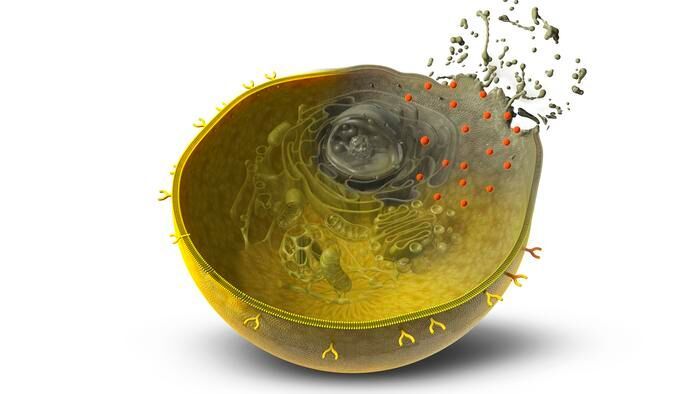
A new AI-based method can produce specially designed proteins in just a few weeks that can arm the T cells in the body's immune system to attack and kill cancer cells.
(Source: Claus Lunau)
Precision cancer treatment on a larger scale is moving closer after researchers have developed an AI platform that can tailor protein components and arm the patient's immune cells to fight cancer. The new method, published in the scientific journal Science, demonstrates for the first time, that it is possible to design proteins in the computer for redirecting immune cells to target cancer cells through pMHC molecules. This dramatically shortens the process of finding effective molecules for cancer treatment from years to a few weeks.
“We are essentially creating a new set of eyes for the immune system. Current methods for individual cancer treatment are based on finding so-called T-cell receptors in the immune system of a patient or donor that can be used for treatment. This is a very time-consuming and challenging process. Our platform designs molecular keys to target cancer cells using the AI platform, and it does so at incredible speed, so that a new lead molecule can be ready within 4-6 weeks,” says Associate Professor at the Technical University of Denmark (DTU) and last author of the study Timothy P. Jenkins.
The AI platform, developed by a team from DTU and the American Scripps Research Institute, aims to solve a major challenge in cancer immunotherapy by demonstrating how scientists can generate target treatments for tumor cells and avoid damaging healthy tissue.
Normally, T cells naturally identify cancer cells by recognizing specific protein fragments, known as peptides, presented on the cell surface by molecules called pMHCs.It is a slow and challenging process to utilise this knowledge for therapy, often because the variation in the body's own T-cell receptors makes it challenging to create a personalised treatment.
Boosting the Body’s Immune System
In the study, the researchers tested the strength of the AI platform on a well-known cancer target, NY-ESO-1, which is found in a wide range of cancers. The team succeeded in designing a minibinder that bound tightly to the NY-ESO-1 pMHC molecules. When the designed protein was inserted into T cells, it created a unique new cell product named ‘IMPAC-T’ cells by the researchers, which effectively guided the T cells to kill cancer cells in laboratory experiments.
“It was incredibly exciting to take these minibinders, which were created entirely on a computer, and see them work so effectively in the laboratory,” says postdoc Kristoffer Haurum Johansen, co-author of the study and researcher at DTU.
The researchers also applied the pipeline to design binders for a cancer target identified in a metastatic melanoma patient, successfully generating binders for this target as well. This documented that the method also can be used for tailored immunotherapy against novel cancer targets.
A crucial step in the researchers’ innovation was the development of a ‘virtual safety check’. The team used AI to screen their designed minibinders and assess them in relation to pMHC molecules found on healthy cells. This method enabled them to filter out minibinders that could cause dangerous side effects before any experiments were carried out.
“Precision in cancer treatment is crucial. By predicting and ruling out cross-reactions already in the design phase, we were able to reduce the risk associated with the designed proteins and increase the likelihood of designing a safe and effective therapy,” says DTU professor and co-author of the study Sine Reker Hadrup.
Five Years to Treatment
Timothy Patrick Jenkins expects that it will take up to five years before the new method is ready for initial clinical trials in humans. Once the method is ready, the treatment process will resemble current cancer treatments using genetically modified T cells, known as CAR-T cells, which are currently used to treat lymphoma and leukaemia. Patients will first have blood drawn at the hospital, similar to a routine blood test. Their immune cells will then be extracted from this blood sample and modified in the laboratory to carry the AI-designed minibinders. These enhanced immune cells are returned to the patient, where they act like targeted missiles, precisely finding and eliminating cancer cells in the body.
Original Article: De novo-designed pMHC binders facilitate T cell-mediated cytotoxicity towards cancer cells; Science; DOI:10.1126/science.adv0422
Date: 08.12.2025
Naturally, we always handle your personal data responsibly. Any personal data we receive from you is processed in accordance with applicable data protection legislation. For detailed information please see our privacy policy.
Consent to the use of data for promotional purposes
I hereby consent to Vogel Communications Group GmbH & Co. KG, Max-Planck-Str. 7-9, 97082 Würzburg including any affiliated companies according to §§ 15 et seq. AktG (hereafter: Vogel Communications Group) using my e-mail address to send editorial newsletters. A list of all affiliated companies can be found here
Newsletter content may include all products and services of any companies mentioned above, including for example specialist journals and books, events and fairs as well as event-related products and services, print and digital media offers and services such as additional (editorial) newsletters, raffles, lead campaigns, market research both online and offline, specialist webportals and e-learning offers. In case my personal telephone number has also been collected, it may be used for offers of aforementioned products, for services of the companies mentioned above, and market research purposes.
Additionally, my consent also includes the processing of my email address and telephone number for data matching for marketing purposes with select advertising partners such as LinkedIn, Google, and Meta. For this, Vogel Communications Group may transmit said data in hashed form to the advertising partners who then use said data to determine whether I am also a member of the mentioned advertising partner portals. Vogel Communications Group uses this feature for the purposes of re-targeting (up-selling, cross-selling, and customer loyalty), generating so-called look-alike audiences for acquisition of new customers, and as basis for exclusion for on-going advertising campaigns. Further information can be found in section “data matching for marketing purposes”.
In case I access protected data on Internet portals of Vogel Communications Group including any affiliated companies according to §§ 15 et seq. AktG, I need to provide further data in order to register for the access to such content. In return for this free access to editorial content, my data may be used in accordance with this consent for the purposes stated here. This does not apply to data matching for marketing purposes.
Right of revocation
I understand that I can revoke my consent at will. My revocation does not change the lawfulness of data processing that was conducted based on my consent leading up to my revocation. One option to declare my revocation is to use the contact form found at https://contact.vogel.de. In case I no longer wish to receive certain newsletters, I have subscribed to, I can also click on the unsubscribe link included at the end of a newsletter. Further information regarding my right of revocation and the implementation of it as well as the consequences of my revocation can be found in the data protection declaration, section editorial newsletter.




:quality(80)/p7i.vogel.de/wcms/ac/24/ac2495bc671ef2a8bf95bdb0de7f172a/0131908887v1.jpeg "An artistic rendering of a boron nitride nanotube developed by UIC researchers and their collaborators in a new study. (Source: Rendering by Ella Maru Studio, Inc. Courtesy of Sangil Kim)")
:quality(80)/p7i.vogel.de/wcms/dd/be/ddbe621ac35ec49d9aee43615173f703/0131898392v2.jpeg "The acquisition is consistent with GSK’s strategy of acquiring assets that have validated targets and meaningfully address efficacy and/or tolerability limitations of existing standard-of-care therapies. (Source: Pixabay)")
:quality(80)/p7i.vogel.de/wcms/e2/ae/e2aea4192de2e22dd33d19afee25f312/0131779278v1.jpeg "The artificial photosynthesis system produces formic acid from carbon dioxide and water. The right image shows the group’s unique electrolyzer.
(Source: Osaka Metropolitan University)")
:quality(80)/p7i.vogel.de/wcms/49/03/49033fd7e1cb79cd90776e8d0583b441/0131773380v1.jpeg "Taken from above, this annotated image shows a schoolground in Spain and the motions of teenage participants as indicated by the dots and lines. (Source: Echeverría-Huarte et al.)")
:quality(80)/p7i.vogel.de/wcms/f5/8d/f58d7181bd0660dea9e33b89f15947eb/0131589395v2.jpeg "Equipping all your HPLC systems running standard separation protocols with an automated non-invasive flow monitoring system, such as Flowchrom, is the only true solution. (Source: Testa Analytical)")
:quality(80)/p7i.vogel.de/wcms/63/44/63443a618001fbdc12e18de386a7b548/0131588936v2.jpeg "These compact, chemically inert degassers use trusted Degasi degasser parts, combined in a manner optimized to your specific system requirements. (Source: Biotech Fluidics)")
:quality(80)/p7i.vogel.de/wcms/47/13/4713969ee1fed4c9d6cd932df7c82482/0131588920v2.jpeg "My Genius Pro installed at a leading European transplant center supporting routine infectious disease testing. (Source: Elitech Group)")
:quality(80)/p7i.vogel.de/wcms/45/d9/45d9cf5be3c10b389fd712f319fbfce1/0131588911v2.jpeg "The Nexis GC-2060 supports both routine and ad-hoc analyses through a range of workflow support functions tailored to operational needs – from automating analytical tasks to on-demand operation that analyses exactly what is needed, when it is needed. (Source: Shimadzu)")
:quality(80)/p7i.vogel.de/wcms/b6/6a/b66a4a25066ff8e426cd9f574b72c7b9/0131905275v1.jpeg "PLA plastic (left piece) usually takes months to break down in industrial composting facilities, but incorporating a sprinkling of an organic additive dramatically speeds the process for a modified PLA plastic (right piece) to less than three weeks.
(Source: Jinsol Yook)")
:quality(80)/p7i.vogel.de/wcms/9f/d8/9fd8ffb67c1132b4f48dc60e4e194226/0131784166v2.jpeg "Still life featuring protein beads loaded with potassium hydroxide. The porous act as a sponge for CO2. (Source: Mezzenga Lab / ETH Zurich)")
:quality(80)/p7i.vogel.de/wcms/3e/47/3e472068bf13aadf4786e947ae148759/0131779258v2.jpeg "Salts, organic matter and other chemical constituents in natural fresh water and seawater suppress sunlight's ability to degrade plastic. Because sunlight cannot effectively initiate the degradation process, microbes cannot finish the job. That means nature’s cleanup process slows down, allowing plastics to accumulate and persist in waterways around the world. (Source: Ludmilla Aristilde/ Northwestern University)")
:quality(80)/p7i.vogel.de/wcms/bc/bc/bcbcf8be4b6c996f6ff231cb65937953/0131673749v1.jpeg "Sewage overflows occur when untreated sewage enters homes or the environment through broken or clogged pipes, or when the sewage system is overwhelmed. (Source: free licensed)")
:quality(80)/p7i.vogel.de/wcms/ac/33/ac339ce19b25f78e11a8dc8ef137869b/0131904977v2.jpeg "An “electronic nose” created by UC Berkeley researchers can detect the gases emitted by spoiled food and food allergens better than human noses. (Source: Brandon Sánchez-Mejia/ UC Berkeley)")
:quality(80)/p7i.vogel.de/wcms/b2/f9/b2f99d68013e2a6ab65e6c86254ec8a9/0131802730v2.jpeg "The UK currently eats 31 % less seafood than is recommended by government guidelines. (Source: University of Bristol)")
:quality(80)/p7i.vogel.de/wcms/1e/ed/1eed2310aac6373fe3d57c8f9d2809d6/0131673857v2.jpeg "“Addressing structural and policy-related barriers to accessing fresh and minimally processed foods remains critical for promoting dietary changes that improve the health and life span for all Americans,” said Dariush Mozaffarian, cardiologist and director of the Food is Medicine Institute at the Friedman School of Nutrition Science and Policy at Tufts University.
(Source: Imani Khayaam for Tufts University)")
:quality(80)/p7i.vogel.de/wcms/48/97/4897129d96e4ab9287933406b153ab51/0131163956v2.jpeg "Eating one egg per day for at least five days a week reduces risk of Alzheimer’s by up to 27%, researchers found. (Source: free licensed)")
:quality(80)/p7i.vogel.de/wcms/17/20/1720579fad3f2e89bc1e190e42ee7c8f/0131911326v2.jpeg "Wild cotton, on left, has short, brown, and coarse fibers, while modern domesticated cotton has white, fine and abundant fibers. A new study led by Iowa State University scientists identified the northwestern Yucatan Peninsula in Mexico as the original source of domesticated cotton. (Source: Corrinne Grover/ Iowa State Universit)")
:quality(80)/p7i.vogel.de/wcms/e0/47/e0471aba187b684e713df3c4d63461f8/0131909497v1.jpeg "Banded mongooses (Mungos mungo) can cooperate with common warthogs (Phacochoerus africanus) by cleaning them, removing ticks and other parasites, while the warthogs provide access to food and safety from predators through their vigilance and presence. Example footage from Queen Elizabeth National Park, Uganda.
(Source: Leela Channer)")
:quality(80)/p7i.vogel.de/wcms/db/28/db28c59875bbfbeae78aac866c08ffa3/0131901880v2.jpeg "Scientists at Northwestern University and Shirley Ryan Abilitylab have developed a first-of-its-kind rehabilitation system that virtually connects therapists and patients through robotic exoskeletons. (Source: Shirley Ryan Abilitylab)")
:quality(80)/p7i.vogel.de/wcms/bb/51/bb51f90e36d72be4dd360c026642b09c/0131843656v2.jpeg "As patients live longer, they are at an increased risk of developing valvular heart disease after successful cancer therapy. (Source: Pixabay)")
:quality(80)/images.vogel.de/vogelonline/bdb/1710600/1710675/original.jpg "Discover how to set yourself up for success when performing balance-based density determination of solids such as jewelry and precious metals. (Mettler Toledo)")
:quality(80)/images.vogel.de/vogelonline/bdb/1682500/1682579/original.jpg "The new XPR Analytical balance redesigned to meet the needs of laboratory technicians of working fast and lean. (Mettler Toledo)")
:quality(80)/images.vogel.de/vogelonline/bdb/1677000/1677080/original.jpg "Enhance your weighing accuracy, comfort and productivity with the redesigned XPR Analytical balance. (Mettler Toledo)")
:fill(fff,0)/p7i.vogel.de/companies/5f/3f/5f3f63ceedc78/knf-logo.jpg "KNF_Logo.jpg (www.knf.com)")
:fill(fff,0)/p7i.vogel.de/companies/69/b7/69b7f63f311d9/logo-bimos-tif--2-.jpeg "logo-bimos-tif--2- (https://www.bimos.com/de-de/)")
:quality(80)/p7i.vogel.de/wcms/a4/b4/a4b4a4b30951e2d13d177685bfd9443f/0125247590v2.jpeg "Researchers at the University of Minnesota have completed a first-in-human clinical trial testing a Crispr/Cas9 gene-editing technique to help the immune system fight advanced gastrointestinal cancers. (Source: Pixabay)")
:quality(80)/p7i.vogel.de/wcms/6e/b4/6eb490e9ca40cb42034b3052a874e46e/0129778274v2.jpeg "The researchers tested a specific class of these PLPs, called Hydracs (Hybrid Degrading Copolymers), on two particularly problematic proteins: MYC and KRAS. (Source: Nathan Gianneschi/Northwestern University)")
:quality(80)/p7i.vogel.de/wcms/a1/fa/a1fa8b58dec1480da3b20c7b9ffabb2d/0131301715v2.jpeg "By tagging nanoparticles with unique DNA “barcodes”, the NUS research team was able to track and compare dozens of designs simultaneously in living tumor models, rapidly identifying those most effective at reaching mitochondria (energy centres inside cancer cells). (Source: NUS)")