



:quality(80)/p7i.vogel.de/wcms/55/f2/55f26cfb29878f58625b4697bacff0b9/0132894544v2.jpeg "The programme is designed to build an integrated R&D platform for sustainable specialty polymers. (Source: NUS)")
:quality(80)/p7i.vogel.de/wcms/2d/9e/2d9ea6bd89a718c2eb6a99172c3b92ad/0132813039v2.jpeg "A new nontargeted chemical analysis of 113 personal care and cleaning products in the US found that nearly all contained unlabeled chemicals. (Source: free licensed)")
:quality(80)/p7i.vogel.de/wcms/1e/cb/1ecbe8d7e82ac7dcfefef112d32415a3/0132811057v1.jpeg "A study of 426 university students highlights the combined importance of laboratory safety practices and healthy dietary habits. (Source: free licensed)")
:quality(80)/p7i.vogel.de/wcms/17/c0/17c0660deff66cc5f9b09a0e3b3286b5/0132714162v1.jpeg "Due to its unique properties, green hydrogen may be a promising tool to achieve a low-carbon economy. (Source: free licensed)")
:quality(80)/p7i.vogel.de/wcms/13/d3/13d35105f74a1c2e22b9c7a270e8e9b3/0132611155v2.jpeg "Circulating cell free DNA. (Source: Amsbio)")
:quality(80)/p7i.vogel.de/wcms/bc/ed/bced6850297a04dbea471a66cb6bb6fe/0132611405v2.jpeg "The latest addition to the range is a peristaltic tubing stop adapter that eliminates the need for fixed stoppers and allows custom cut lengths of peristaltic tubing to be installed on any pump head size. (Source: Biotech Fluidics )")
:quality(80)/p7i.vogel.de/wcms/c2/34/c234a6626d4f6360382ca7f1f440bebb/0132611196v2.jpeg "Testa Analytical's Trinity – a powerful new triple detector for Gel Permeation Chromatography / Size Exclusion Chromatography. (Source: Testa Analytical)")
:quality(80)/p7i.vogel.de/wcms/5b/3f/5b3fc0d5fb08c1f9727125bd926b1481/0132555049v1.jpeg "On 1 and 2 December 2026, the T3 – Transform The Tomorrow conference will explore strategies that help companies future-proof their operations. (Bild: © Vogel Corporate Solutions / AdobeStock 1280236166, Oksana)")
:quality(80)/p7i.vogel.de/wcms/d5/a3/d5a33f32cd6adf709c8afefc998d3f04/0132845576v1.jpeg "The study shows that the foreign media are less likely to report on certain effects of climate change, such as droughts and flooding (shown here: the 2021 Ahrtal floods). (Source: Volker Lannert/ Uni Bonn)")
:quality(80)/p7i.vogel.de/wcms/c9/a3/c9a33d5a20f5de3775aebaf763f5d336/0132811091v1.jpeg "A commercial plant operated by Heirloom Carbon Technologies, featuring air contactors where CO₂ is captured from the atmosphere. (Source: Heirloom Carbon Technologies)")
:quality(80)/p7i.vogel.de/wcms/06/1a/061a5d3a4e85383454d9450761a67de7/0132611653v2.jpeg "Shihong Lin, associate professor of civil and environmental engineering at Rice. (Source: Alex Becker/ Rice University)")
:quality(80)/p7i.vogel.de/wcms/c4/f5/c4f55f42fdf878aec3f850e5569b84ce/0132594173v2.jpeg "The latest research sheds some light on an issue that deserves more attention, that of climate-related suicide. (Source: Unsplash)")
:quality(80)/p7i.vogel.de/wcms/79/76/7976d17b980bedfe35acaa532d690046/0132713841v2.jpeg "Observed rice yield losses from 1°C warming are more than twice as high as model estimates due to underestimated heat stress. (Source: AdobeStock/ducvien)")
:quality(80)/p7i.vogel.de/wcms/28/b6/28b6114fc9915c5dadee94d5c89bd129/0132593216v2.jpeg "Eating foods that contain common preservative food additives may increase the risks of high blood pressure and cardiovascular disease. (Source: Unsplash)")
:quality(80)/p7i.vogel.de/wcms/01/bc/01bcb16a3381a1d46533861eedbbae71/0132371290v1.jpeg "Adding spice may help people eat less by slowing them down. (Source: free licensed)")
:quality(80)/p7i.vogel.de/wcms/b3/16/b316ac585e067d024da89a5156c950a9/0132370983v1.jpeg "Laboratory tests suggest that some low-calorie sweeteners can alter the growth of gut bacteria, with particularly strong effects observed when isosteviol was combined with the antidepressant duloxetine. (Source: free licensed)")
:quality(80)/p7i.vogel.de/wcms/18/a2/18a2be5f679b4866ec2998893a9ebad8/0132889573v2.jpeg "From left: Gan Wei Liang; Associate Professor Polly Leilei Chen, Principal Investigator and corresponding author; Dr Larry Ng, first author; and Vincent Tano, second author. (Source: National University of Singapore )")
:quality(80)/p7i.vogel.de/wcms/da/25/da253a36e80bc88964b041671efb2618/0132845600v1.jpeg "BMI alone missed a substantial number of people who met body-fat criteria for obesity. (Source: free licensed)")
:quality(80)/p7i.vogel.de/wcms/76/50/76509977289d6b9fc4dfaa52499278be/0132808384v1.jpeg "High-tech alternatives to animal testing, modular µSiM (m-µSiM) tissue chip platform components are mass-produced and primarily acrylic, which allows for the assembly of highly reproducible devices. (Source: J. Adam Fenster / University of Rochester)")
:quality(80)/p7i.vogel.de/wcms/32/3b/323b2207a287feaf3b0ff742517b6af4/0132809996v1.jpeg "The arboreal ant Temnothorax affinis. Some ant species in this genus swarm in synchronized waves that start with a “first mover” ant. (Source: Gilles San Martin)")
:quality(80)/images.vogel.de/vogelonline/bdb/1710600/1710675/original.jpg "Discover how to set yourself up for success when performing balance-based density determination of solids such as jewelry and precious metals. (Mettler Toledo)")
:quality(80)/images.vogel.de/vogelonline/bdb/1682500/1682579/original.jpg "The new XPR Analytical balance redesigned to meet the needs of laboratory technicians of working fast and lean. (Mettler Toledo)")
:quality(80)/images.vogel.de/vogelonline/bdb/1677000/1677080/original.jpg "Enhance your weighing accuracy, comfort and productivity with the redesigned XPR Analytical balance. (Mettler Toledo)")
:fill(fff,0)/images.vogel.de/vogelonline/companyimg/131900/131910/65.jpg "Xylem_tag_rgb.jpg ()")
:fill(fff,0)/p7i.vogel.de/companies/69/b7/69b7f63f311d9/logo-bimos-tif--2-.jpeg "logo-bimos-tif--2- (https://www.bimos.com/de-de/)")
Date: 08.12.2025
Naturally, we always handle your personal data responsibly. Any personal data we receive from you is processed in accordance with applicable data protection legislation. For detailed information please see our privacy policy.
Consent to the use of data for promotional purposes
I hereby consent to Vogel Communications Group GmbH & Co. KG, Max-Planck-Str. 7-9, 97082 Würzburg including any affiliated companies according to §§ 15 et seq. AktG (hereafter: Vogel Communications Group) using my e-mail address to send editorial newsletters. A list of all affiliated companies can be found here
Newsletter content may include all products and services of any companies mentioned above, including for example specialist journals and books, events and fairs as well as event-related products and services, print and digital media offers and services such as additional (editorial) newsletters, raffles, lead campaigns, market research both online and offline, specialist webportals and e-learning offers. In case my personal telephone number has also been collected, it may be used for offers of aforementioned products, for services of the companies mentioned above, and market research purposes.
Additionally, my consent also includes the processing of my email address and telephone number for data matching for marketing purposes with select advertising partners such as LinkedIn, Google, and Meta. For this, Vogel Communications Group may transmit said data in hashed form to the advertising partners who then use said data to determine whether I am also a member of the mentioned advertising partner portals. Vogel Communications Group uses this feature for the purposes of re-targeting (up-selling, cross-selling, and customer loyalty), generating so-called look-alike audiences for acquisition of new customers, and as basis for exclusion for on-going advertising campaigns. Further information can be found in section “data matching for marketing purposes”.
In case I access protected data on Internet portals of Vogel Communications Group including any affiliated companies according to §§ 15 et seq. AktG, I need to provide further data in order to register for the access to such content. In return for this free access to editorial content, my data may be used in accordance with this consent for the purposes stated here. This does not apply to data matching for marketing purposes.
Right of revocation
I understand that I can revoke my consent at will. My revocation does not change the lawfulness of data processing that was conducted based on my consent leading up to my revocation. One option to declare my revocation is to use the contact form found at https://contact.vogel.de. In case I no longer wish to receive certain newsletters, I have subscribed to, I can also click on the unsubscribe link included at the end of a newsletter. Further information regarding my right of revocation and the implementation of it as well as the consequences of my revocation can be found in the data protection declaration, section editorial newsletter.
:quality(80)/p7i.vogel.de/wcms/d5/14/d5144a87f3c04019e3338c738a9c02ed/0126611086v1.jpeg "Detectors are created from cutting and polishing specific sizes from the boules. (Source: Mercouri Kanatzidis/Northwestern University)")
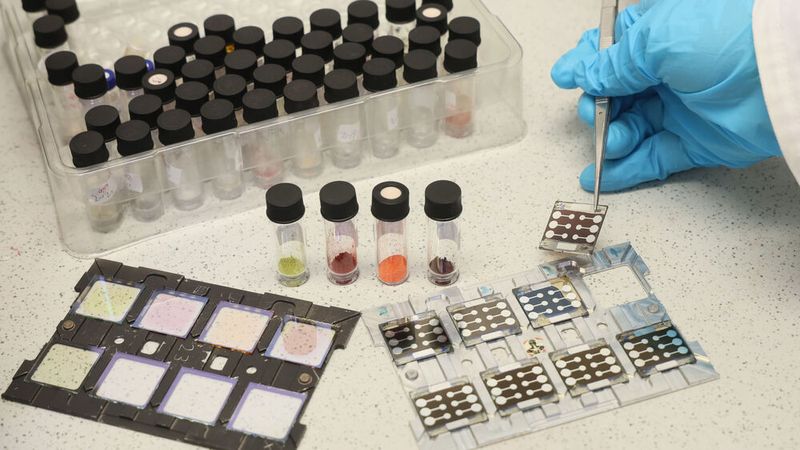
:quality(80)/p7i.vogel.de/wcms/54/10/541074a20cfd535b1f62d1047da3f32d/0127813307v1.jpeg "A fluorinated compound between the perovskite and the buckyball (C60) contact layer forms an almost monomolecular film that acts as a chemical protective barrier and increases the stability of the cell. (Source: Guixiang Li/Nature Photonics 2025)")