Researchers have developed a new smartwatch that can continuously monitor blood pressure with clinical accuracy. The technology has the potential to revolutionize how cardiovascular health is managed.
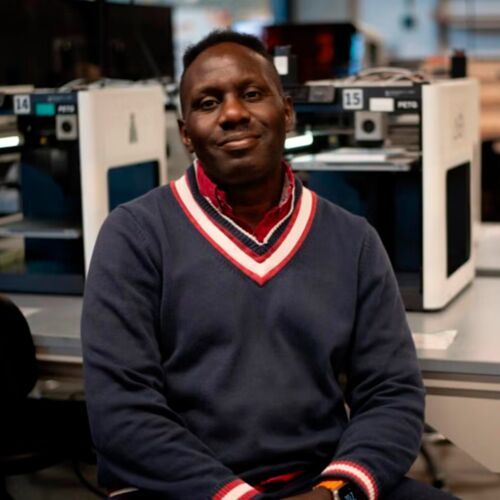
Lead researcher Deji Akinwande sits at a workstation in a biomedical engineering lab at the University of Texas at Austin.
(Source: University of Texas at Austin)
Texas/USA – A new smartwatch, being developed by researchers from The University of Texas at Austin and North Carolina State University, will enable continuous monitoring of blood pressure, a key indicator of heart health. Cardiovascular diseases represent the leading cause of death worldwide, claiming 18 million lives annually, but these conditions often go undetected due to the infrequency of routine medical checkups. Traditional blood pressure monitoring devices, such as cuffs, are cumbersome and not designed for continuous at-home use, leaving a critical gap in health care.
The researchers received a three-year contract from the Advanced Research Projects Agency for Health (ARPA-H), worth up to 2.5 million dollars, to fill that health care gap. The work builds on an electronic tattoo for blood pressure monitoring that the researchers developed four years ago. The new project represents a bold technical leap forward.
“Our goal is to create a wearable device that can monitor blood pressure unobtrusively and with clinical accuracy,” said Deji Akinwande, professor in the Chandra Family Department of Electrical and Computer Engineering and Department of Biomedical Engineering and the lead researcher on the project. “This technology has the potential to revolutionize how we manage cardiovascular health, providing individuals and health care providers with the data they need to make informed decisions and take proactive measures.”
The project is structured into two phases over three years, with specific milestones and deliverables each year. In Phase 1, the first year, the team will focus on developing the foundational technology, including designing and validating the smartwatch antenna, creating an alpha version of the core chip for measuring the body’s signals, and developing initial machine learning algorithms for blood pressure estimation.
Phase 2 includes years 2 and 3. The second year will see the integration of the technology into a smartwatch prototype, complete with a smartphone app for real-time data visualization and analytics. By the third year, the researchers aim to deliver a fully functional smartwatch prototype.
The final product, Smartwatch BP Prototype 3.0, will feature multimodal sensing capabilities, powered by advanced machine learning algorithms and edge computing technology, to correlate blood pressure with other vital signs, human activities, and environmental factors such as temperature and humidity. The smartwatch will be designed to meet the highest industry standards for blood pressure measurement accuracy.
In medicine, cuff-less blood pressure monitoring is a major priority, but a mainstream option has yet to surface. It’s part of a larger push in medicine to use technology to untether patients from machines while collecting more data wherever they are, allowing them to move from room to room, clinic to clinic and still receive personalized care.
“This is more than just a smartwatch; it’s a tool for empowering individuals to take control of their health,” said Hirofumi Tanaka, professor in the College of Education’s Department of Kinesiology and Health Education at UT. “By providing continuous, clinically accurate blood pressure monitoring, we can help people identify potential health issues early and take action to prevent them.”
The device measures its readings by passing an electrical signal through the skin and then analyzing the body’s response, a process known as bioimpedance. There is a correlation between bioimpedance and changes in blood pressure that is related to changes in blood volume. However, the correlation is not particularly obvious, so the team will employ machine learning models to analyze the connection and obtain accurate blood pressure readings.
Unlike other emerging bioimpedance methods that require direct skin contact, the smartwatch will use radio-frequency (RF) waves emitted and received by an antenna integrated into the device. This approach eliminates the need for intimate skin contact, making the device more comfortable and suitable for long-term use.
Date: 08.12.2025
Naturally, we always handle your personal data responsibly. Any personal data we receive from you is processed in accordance with applicable data protection legislation. For detailed information please see our privacy policy.
Consent to the use of data for promotional purposes
I hereby consent to Vogel Communications Group GmbH & Co. KG, Max-Planck-Str. 7-9, 97082 Würzburg including any affiliated companies according to §§ 15 et seq. AktG (hereafter: Vogel Communications Group) using my e-mail address to send editorial newsletters. A list of all affiliated companies can be found here
Newsletter content may include all products and services of any companies mentioned above, including for example specialist journals and books, events and fairs as well as event-related products and services, print and digital media offers and services such as additional (editorial) newsletters, raffles, lead campaigns, market research both online and offline, specialist webportals and e-learning offers. In case my personal telephone number has also been collected, it may be used for offers of aforementioned products, for services of the companies mentioned above, and market research purposes.
Additionally, my consent also includes the processing of my email address and telephone number for data matching for marketing purposes with select advertising partners such as LinkedIn, Google, and Meta. For this, Vogel Communications Group may transmit said data in hashed form to the advertising partners who then use said data to determine whether I am also a member of the mentioned advertising partner portals. Vogel Communications Group uses this feature for the purposes of re-targeting (up-selling, cross-selling, and customer loyalty), generating so-called look-alike audiences for acquisition of new customers, and as basis for exclusion for on-going advertising campaigns. Further information can be found in section “data matching for marketing purposes”.
In case I access protected data on Internet portals of Vogel Communications Group including any affiliated companies according to §§ 15 et seq. AktG, I need to provide further data in order to register for the access to such content. In return for this free access to editorial content, my data may be used in accordance with this consent for the purposes stated here. This does not apply to data matching for marketing purposes.
Right of revocation
I understand that I can revoke my consent at will. My revocation does not change the lawfulness of data processing that was conducted based on my consent leading up to my revocation. One option to declare my revocation is to use the contact form found at https://contact.vogel.de. In case I no longer wish to receive certain newsletters, I have subscribed to, I can also click on the unsubscribe link included at the end of a newsletter. Further information regarding my right of revocation and the implementation of it as well as the consequences of my revocation can be found in the data protection declaration, section editorial newsletter.
The researchers have filed an application to patent this technology. They are exploring forming a startup around their work.
“This research provides a pathway to a practical product that millions of people around the world can use,” said Yaoyao Jia, an associate professor of electrical and computer engineering at UT. “Our collaboration with AI, hardware and industry leaders will ensure that this technology is not only scientifically sound but also practical and accessible to the public.”
In addition to the interdisciplinary UT team, the researchers collaborated with Edgar Lobaton, a professor of electrical and computer engineering at North Carolina State University and an expert on integrating AI and modeling technologies into cyber-physical systems such as health care devices and rehabilitation robots.




:quality(80)/p7i.vogel.de/wcms/aa/39/aa398d3e6667bdb43ad57abf38dc394c/0129347450v2.jpeg "An illustration shows a strand of engineered DNA passing through a nanoscale sensor, where its physical structure can be decoded as digital information. DNA nanostructures could one day serve as ultra-dense carriers of digital information and advance the field of data encryption. (Source: Jason Drees/ ASU)")
:quality(80)/p7i.vogel.de/wcms/06/a1/06a11f1d752afb35854aa9e1afb62e98/0129209625v2.jpeg "“Unsinkable\" metal tube made from chemically-etched aluminum floats in distilled water at the lab of University of Rochester professor Chunlei Guo. (Source: J. Adam Fenster / University of Rochester)")
:quality(80)/p7i.vogel.de/wcms/6d/df/6ddf023361ec7f8fbfb6c56521577960/0129056554v2.jpeg "The evolution of carburization (depicted by the spheres) under kinetic control (illustrated by the surface contours). The molecular beams represent gas evolution under synthesis conditions while the fiery sphere highlights the formation of the pure tungsten semi-carbide phase with additional molecular beams at the top to illustrate its catalytic performance. (Source: Sinhara M. H. D. Perera)")
:quality(80)/p7i.vogel.de/wcms/26/3d/263d97f8f2797267ecf2781b56882758/0129056451v1.jpeg "A study by the Complexity Science Hub finds that AI systems are already involved in nearly one-third of newly written software code, with rapid adoption in the United States and Europe and measurable productivity gains mainly for experienced developers. (Source: free licensed)")
:quality(80)/p7i.vogel.de/wcms/11/74/1174e5d4c8b07a64637dced8c9506b40/0129787561v2.jpeg "The Multicell Plus high-pressure reactor sets a new benchmark for operator safety, all-round accessibility and ease-of-use. (Source: Asynt)")
:quality(80)/p7i.vogel.de/wcms/ef/6e/ef6e96191183411973b77041fb6b1e16/0129785957v2.jpeg "Manufactured from high-quality crystal polystyrene - these new automation-ready plates are available in a choice of ANSI / SLAS standard (96-well and breakable 8-well strip) formats. (Source: Porvair Sciences)")
:quality(80)/p7i.vogel.de/wcms/ad/ca/adcaa20ef5ccaf7e3b325788b1e349c4/0129784872v2.jpeg "The high performance Degasi Flat Film in-line degasser. (Source: Biotech Fluidics)")
:quality(80)/p7i.vogel.de/wcms/22/d8/22d876eb82626568e404ebae75053986/0129781861v2.jpeg "Uniqsis has introduced a novel Tube-in-plate reactor that provides a cost-effective alternative to glass static mixer reactor blocks for highly exothermic or fast, mixing-dependent reactions. (Source: Uniqsis)")
:quality(80)/p7i.vogel.de/wcms/a3/52/a3527437a0f0bba5e58559a5c78e4f7a/0129797135v2.jpeg "PFAS have been used in a range of products, including non-stick cookware, cosmetics and fire extinguisher foam. (Source: free licensed)")
:quality(80)/p7i.vogel.de/wcms/05/94/0594c8529e29bf70b31c0f8db2e7a3cd/0129797089v1.jpeg "In related research, a team led by Princeton Professors Z. Jason Ren and Mark Zondlo studied emissions from U.S. wastewater plants.
(Source: Nathan Li/ Princeton University)")
:quality(80)/p7i.vogel.de/wcms/b5/05/b505af30c4c5d568073b613a9e9a1541/0129779931v2.jpeg "Researchers tested what factors improve or worsen the quality of sleep in mice. (Source: Pixabay)")
:quality(80)/p7i.vogel.de/wcms/8c/39/8c392d01443d1dd972c8c1b498514199/0129776466v2.jpeg "Individuals exposed as children to indoor air pollution from solid fuels performed significantly worse on cognitive tests in adulthood. (Source: Pixabay)")
:quality(80)/p7i.vogel.de/wcms/84/2c/842c7c1678ceeec7147ea3a36e238e75/0129356324v2.jpeg "Kaust and Nadec have signed a MOU that establishes a framework for long-term cooperation across agricultural research, technology development, and professional training. (Source: Kaust )")
:quality(80)/p7i.vogel.de/wcms/d1/3c/d13c2ad34af600dbd360c0bb0990b922/0129045715v2.jpeg "Replacing animal products with plant-based foods helps reduce the risk of heart disease and type 2 diabetes, finds a new review by the Physicians Committee for Responsible Medicine. (Source: Pixabay)")
:quality(80)/p7i.vogel.de/wcms/e1/b3/e1b3e26d03101ba93b76b304da150c9a/0129025388v2.jpeg "The research reanalyzed data from a seminal clinical trial, led by US National Institutes of Health veteran Dr Kevin Hall, which first exposed how eating exclusively UPFs results in excessive calorie consumption and weight gain. (Source: Pixabay)")
:quality(80)/p7i.vogel.de/wcms/75/db/75db8afe45607bee750df705e22b60e9/0128938816v1.jpeg "A new academic review suggests that bamboo shoots could offer significant health benefits, including improved blood sugar control, gut health and antioxidant activity. (Source: free licensed)")
:quality(80)/p7i.vogel.de/wcms/e6/49/e649f8e8a4b990611fd1c1d8a1aa50a5/0129797212v2.jpeg "Case 6, photographed by Dr Jose de la Fuente. Amber now held in the KGJ Colección, Ciudad Real. (Source: Dr Jose de la Fuente)")
:quality(80)/p7i.vogel.de/wcms/2b/1b/2b1b4dcdea620784c5f7beb1a865f618/0129797180v1.jpeg "Graphical illustration of how this research is envisioned in humans (Source: Houston Methodist)")
:quality(80)/p7i.vogel.de/wcms/a4/e8/a4e8c7b44b600ad8609fcfad11088b72/0129797160v1.jpeg "The sleep biology of adolescents is geared towards falling asleep late. With school starting early these days, chronic sleep deprivation can occur. (Source: free licensed)")
:quality(80)/p7i.vogel.de/wcms/6e/b4/6eb490e9ca40cb42034b3052a874e46e/0129778274v2.jpeg "The researchers tested a specific class of these PLPs, called Hydracs (Hybrid Degrading Copolymers), on two particularly problematic proteins: MYC and KRAS. (Source: Nathan Gianneschi/Northwestern University)")
:quality(80)/images.vogel.de/vogelonline/bdb/1710600/1710675/original.jpg "Discover how to set yourself up for success when performing balance-based density determination of solids such as jewelry and precious metals. (Mettler Toledo)")
:quality(80)/images.vogel.de/vogelonline/bdb/1682500/1682579/original.jpg "The new XPR Analytical balance redesigned to meet the needs of laboratory technicians of working fast and lean. (Mettler Toledo)")
:quality(80)/images.vogel.de/vogelonline/bdb/1677000/1677080/original.jpg "Enhance your weighing accuracy, comfort and productivity with the redesigned XPR Analytical balance. (Mettler Toledo)")
:quality(80)/p7i.vogel.de/wcms/6f/8a/6f8ad39c13a8ea5a09af36d222ffdd9b/0125682235v2.jpeg "Researchers have developed a new wearable sensor which can continuously measure a person’s hydration levels. (Source: University of Texas at Austin)")
:quality(80)/p7i.vogel.de/wcms/71/0b/710b65311648262eb99c8690377b73dd/0124237452v2.jpeg "Northwestern University researchers have developed the first wearable device for measuring gases emitted from and absorbed by the skin. (Source: John A. Rogers/Northwestern University)")