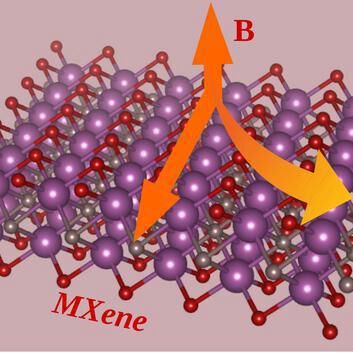
South Korean researchers have successfully developed an innovative analysis model focusing on the magnetic transport characteristics of molecules attached to the surface of MXene. The new approach is expected to facilitate the establishment of a property prediction and classification system, a critical step toward the production of uniform quality MXene for various applications.
Predicted Hall Scattering Factor for Maxin
(Source: Korea Institute of Science and Technology)
Developed in 2011, MXene is a two-dimensional nanomaterial with alternating metal and carbon layers, which has high electrical conductivity and can be combined with various metal compounds, making it a material that can be utilized in various industries such as semiconductors, electronic devices, and sensors. To properly utilize MXene, it is important to know the type and amount of molecules covered on the surface, and if the molecules covered on the surface are fluorine, the electrical conductivity of decreases and the efficiency of electromagnetic wave shielding decreases. However, since it is only 1 nm (nanometer — billionth of a meter) thick, it takes several days to analyze the molecules on the surface even with a high-performance electron microscope, so mass production has been impossible until now.
The research team led by Seung-Cheol Lee, director of the Indo-Korea Science and Technology Center (Ikst) at the Korea Institute of Science and Technology (Kist), has developed a method to predict the distribution of molecules on the surface using the magnetoresistance property of MXene. By utilizing this method, it is possible to measure the molecular distribution of MXene with a simple measurement, enabling quality control in the production process, which is expected to open the way to mass production that was not possible until now.
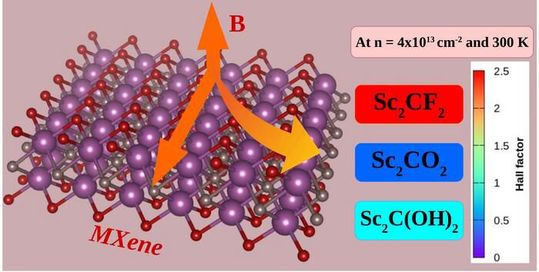
The research team developed a two-dimensional material property prediction program based on the idea that electrical conductivity or magnetic properties change depending on the molecules attached to the surface. As a result, they calculated the magnetic transport properties of MXene and succeeded in analyzing the type and amount of molecules adsorbed on the surface of MXene at atmospheric pressure and room temperature without any additional devices.
Predicted Hall Scattering Factor for Maxin
(Source: Korea Institute of Science and Technology)
By analyzing the surface of the MXene with the developed property prediction program, it was predicted that the Hall scattering factor, which affects magnetic transport, changes dramatically depending on the type of surface molecules. The Hall Scattering Factor is a physical constant that describes the charge-carrying properties of semiconductor materials, and the team found that even when the same MXene was prepared, the Hall Scattering Factor had a value of 2.49, the highest for fluorine, 0.5 for oxygen, and 1 for hydroxide, allowing them to analyze the distribution of the molecules.
The Hall scattering coefficient has different applications based on the value of 1. If the value is lower than 1, it can be applied to high-performance transistors, high-frequency generators, high-efficiency sensors, and photodetectors, and if the value is higher than 1, it can be applied to thermoelectric materials and magnetic sensors. Considering that the size of the maxin is a few nanometers or less, the size of the applicable device and the amount of power required can be dramatically reduced.
“Unlike previous studies that focused on the production and properties of pure MXene, this study is significant in that it provides a new method for surface molecular analysis to easily classify manufactured MXene,” said Seung-Cheol Lee, director of IKist. “By combining this result with experimental studies, we expect to be able to control the production process of MXene, which will be used to mass produce MXene with uniform quality.”
Ikst was established in 2010 and conducts research in the areas of theory, source code, and software for computational science. In particular, source code is a programming language that implements algorithms that can be modeled and simulated, and is considered an original research in the field of computational science, and the center conducts collaborative research with Indian universities and research institutes such as IIT Bombay to develop source code.
References: Can magneto-transport properties provide insight into the functional groups in semiconducting MXenes?; Nanoscale; DOI:10.1039/d2nr06409j
Date: 08.12.2025
Naturally, we always handle your personal data responsibly. Any personal data we receive from you is processed in accordance with applicable data protection legislation. For detailed information please see our privacy policy.
Consent to the use of data for promotional purposes
I hereby consent to Vogel Communications Group GmbH & Co. KG, Max-Planck-Str. 7-9, 97082 Würzburg including any affiliated companies according to §§ 15 et seq. AktG (hereafter: Vogel Communications Group) using my e-mail address to send editorial newsletters. A list of all affiliated companies can be found here
Newsletter content may include all products and services of any companies mentioned above, including for example specialist journals and books, events and fairs as well as event-related products and services, print and digital media offers and services such as additional (editorial) newsletters, raffles, lead campaigns, market research both online and offline, specialist webportals and e-learning offers. In case my personal telephone number has also been collected, it may be used for offers of aforementioned products, for services of the companies mentioned above, and market research purposes.
Additionally, my consent also includes the processing of my email address and telephone number for data matching for marketing purposes with select advertising partners such as LinkedIn, Google, and Meta. For this, Vogel Communications Group may transmit said data in hashed form to the advertising partners who then use said data to determine whether I am also a member of the mentioned advertising partner portals. Vogel Communications Group uses this feature for the purposes of re-targeting (up-selling, cross-selling, and customer loyalty), generating so-called look-alike audiences for acquisition of new customers, and as basis for exclusion for on-going advertising campaigns. Further information can be found in section “data matching for marketing purposes”.
In case I access protected data on Internet portals of Vogel Communications Group including any affiliated companies according to §§ 15 et seq. AktG, I need to provide further data in order to register for the access to such content. In return for this free access to editorial content, my data may be used in accordance with this consent for the purposes stated here. This does not apply to data matching for marketing purposes.
Right of revocation
I understand that I can revoke my consent at will. My revocation does not change the lawfulness of data processing that was conducted based on my consent leading up to my revocation. One option to declare my revocation is to use the contact form found at https://contact.vogel.de. In case I no longer wish to receive certain newsletters, I have subscribed to, I can also click on the unsubscribe link included at the end of a newsletter. Further information regarding my right of revocation and the implementation of it as well as the consequences of my revocation can be found in the data protection declaration, section editorial newsletter.




:quality(80)/p7i.vogel.de/wcms/aa/39/aa398d3e6667bdb43ad57abf38dc394c/0129347450v2.jpeg "An illustration shows a strand of engineered DNA passing through a nanoscale sensor, where its physical structure can be decoded as digital information. DNA nanostructures could one day serve as ultra-dense carriers of digital information and advance the field of data encryption. (Source: Jason Drees/ ASU)")
:quality(80)/p7i.vogel.de/wcms/06/a1/06a11f1d752afb35854aa9e1afb62e98/0129209625v2.jpeg "“Unsinkable\" metal tube made from chemically-etched aluminum floats in distilled water at the lab of University of Rochester professor Chunlei Guo. (Source: J. Adam Fenster / University of Rochester)")
:quality(80)/p7i.vogel.de/wcms/6d/df/6ddf023361ec7f8fbfb6c56521577960/0129056554v2.jpeg "The evolution of carburization (depicted by the spheres) under kinetic control (illustrated by the surface contours). The molecular beams represent gas evolution under synthesis conditions while the fiery sphere highlights the formation of the pure tungsten semi-carbide phase with additional molecular beams at the top to illustrate its catalytic performance. (Source: Sinhara M. H. D. Perera)")
:quality(80)/p7i.vogel.de/wcms/26/3d/263d97f8f2797267ecf2781b56882758/0129056451v1.jpeg "A study by the Complexity Science Hub finds that AI systems are already involved in nearly one-third of newly written software code, with rapid adoption in the United States and Europe and measurable productivity gains mainly for experienced developers. (Source: free licensed)")
:quality(80)/p7i.vogel.de/wcms/21/03/21030cc2541c455da0769decca8d1f82/0129146048v2.jpeg "Vyon porous plastics from Porvair Sciences are the perfect material for filtration applications in the healthcare and medical device market. (Source: Porvair Sciences)")
:quality(80)/p7i.vogel.de/wcms/bd/aa/bdaae5b9d381e2471ab37f479ad43d79/0129143884v2.jpeg "The Solvent Line Monitor from Testa Analytical is a true plug-and-play addition to any HPLC system designed to detect when one or more of its pump solvent reservoirs are empty and automatically shut-off the system. (Source: Testa Analytical)")
:quality(80)/p7i.vogel.de/wcms/8f/66/8f66b8acbb3037ca8e6b320bcad1c817/0129118043v2.jpeg "The Plasmaquant 9200 series is ideal for applications in research, trace analysis and quality control. (Source: Analytik Jena )")
:quality(80)/p7i.vogel.de/wcms/66/82/66825163ab842baded640db1a484e729/0129117548v2.jpeg "Biotech Fluidics has announced the Smartsaver solvent recycling unit which is designed to recover up to 90 % of your mobile phase by redirection of the pure solvent to the solvent reservoir during isocratic HPLC. (Source: Biotech Fluidics )")
:quality(80)/p7i.vogel.de/wcms/1a/4f/1a4fe7f8b5541716ba908251738beca1/0129349759v2.jpeg "Krict’s Syngas-to-Sustainable Aviation Fuel (SAF) Conversion Facility (Source: Korea Research Institute of Chemical Technology (Krict))")
:quality(80)/p7i.vogel.de/wcms/d4/29/d429a973c6f14ced3d2eb44931669a78/0129348927v1.jpeg "Cage-like ulva biochar confined synthesis of Fe₃O₄/ZnO heterojunction nanoparticles for synergistic adsorption and photocatalytic degradation of PFOA
(Source: Hua Jing et. al.)")
:quality(80)/p7i.vogel.de/wcms/86/90/8690b8154a552da13b37f289349b1db4/0129283446v2.jpeg "Lina Pérez-Ángel holds two sediment samples whose ages are separated by about a million years. (Source: Ellen Jorgensen)")
:quality(80)/p7i.vogel.de/wcms/90/f8/90f8c3152a59205a7cac1cc182eb186b/0129209634v2.jpeg "Nitrate in drinking water linked to increased dementia risk while nitrate from vegetables is linked to a lower risk, researchers find . (Source: free licensed)")
:quality(80)/p7i.vogel.de/wcms/84/2c/842c7c1678ceeec7147ea3a36e238e75/0129356324v2.jpeg "Kaust and Nadec have signed a MOU that establishes a framework for long-term cooperation across agricultural research, technology development, and professional training. (Source: Kaust )")
:quality(80)/p7i.vogel.de/wcms/d1/3c/d13c2ad34af600dbd360c0bb0990b922/0129045715v2.jpeg "Replacing animal products with plant-based foods helps reduce the risk of heart disease and type 2 diabetes, finds a new review by the Physicians Committee for Responsible Medicine. (Source: Pixabay)")
:quality(80)/p7i.vogel.de/wcms/e1/b3/e1b3e26d03101ba93b76b304da150c9a/0129025388v2.jpeg "The research reanalyzed data from a seminal clinical trial, led by US National Institutes of Health veteran Dr Kevin Hall, which first exposed how eating exclusively UPFs results in excessive calorie consumption and weight gain. (Source: Pixabay)")
:quality(80)/p7i.vogel.de/wcms/75/db/75db8afe45607bee750df705e22b60e9/0128938816v1.jpeg "A new academic review suggests that bamboo shoots could offer significant health benefits, including improved blood sugar control, gut health and antioxidant activity. (Source: free licensed)")
:quality(80)/p7i.vogel.de/wcms/14/24/14247b96901bfab6c75b7a3453ecfc6e/0129390600v2.jpeg "The US study, ‘Artificial-Intelligence-Enabled Digital Stethoscope Improves Point-of-Care Screening for Moderate to Severe Valvular Heart Disease’, was recently published on Thursday 5 February, 2026 in the European Heart Journal - Digital Health. (Source: Pixabay)")
:quality(80)/p7i.vogel.de/wcms/0d/9b/0d9bcd7e41846276db862456d619edd2/0129351002v2.jpeg "A Caltech-led team has developed a way of making bubble bots with simple protein shells that can be modified by enzymes or magnetic nanoparticles for efficient drug delivery. One version the researchers has made is \"smart\" enough to direct itself to direct itself to a tumor target. (Source: Gao Lab/ Caltech)")
:quality(80)/p7i.vogel.de/wcms/1a/ee/1aee2613e1a69c73ab568ee61d354ded/0129347044v1.jpeg "The Tonks lab studied PTP1B inhibition in a mouse model of Alzheimer’s disease. When PTP1B was deleted, as shown in the bottom row, the brain’s immune cells (green) were better at engulfing harmful amyloid-β plaques (grey), as shown in the left column. (Source: Nicholas Tonks/ CSHL)")
:quality(80)/p7i.vogel.de/wcms/fe/b7/feb7e0d151036b0c2be071e958dbce3b/0129341435v2.jpeg "As youth mental health challenges have risen alongside increased social media use, researchers and policymakers have questioned whether platforms contribute to emotional distress. (Source: Pixabay)")
:quality(80)/images.vogel.de/vogelonline/bdb/1710600/1710675/original.jpg "Discover how to set yourself up for success when performing balance-based density determination of solids such as jewelry and precious metals. (Mettler Toledo)")
:quality(80)/images.vogel.de/vogelonline/bdb/1682500/1682579/original.jpg "The new XPR Analytical balance redesigned to meet the needs of laboratory technicians of working fast and lean. (Mettler Toledo)")
:quality(80)/images.vogel.de/vogelonline/bdb/1677000/1677080/original.jpg "Enhance your weighing accuracy, comfort and productivity with the redesigned XPR Analytical balance. (Mettler Toledo)")
:quality(80)/p7i.vogel.de/wcms/fe/32/fe3264588a5e815d9f0242391c312519/0123895427v2.jpeg "Carbon nanotubes in solution. Carbon nanotubes with different chirality, or“twist”, have different optical properties: one type of nanotube is yellow and the other is violet. (Source: Mikael Nyberg)")
:quality(80)/p7i.vogel.de/wcms/1f/89/1f89ec33f25051fb58ffaecf907661c9/0124984189v1.jpeg "A magnetic sea urchin-shaped material (developed by Kist) is placed inside the pipe where wastewater flows in, and magnets are used on the outside of the pipe to induce self-assembly. The arranged urchin-shaped material can also be easily cleaned by adjusting the magnetic field when it is contaminated by suspended solids in the wastewater. (Source: Korea Institute of Science and Technology)")