A new study has recommended to expand the universal age-based screening from the current 50-80 years to 40-85 years. The researchers estimate that this would help to detect 94 % of lung cancers and thus, prevent more than 26,000 extra deaths annually.
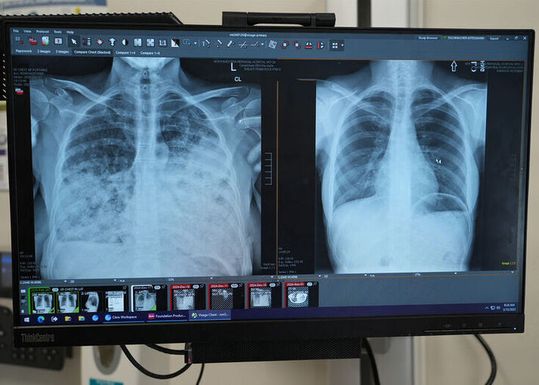
Lung cancer patient scans before and after transplant.
(Source: Northwestern University)
Chicago/USA – In a new study of nearly 1,000 consecutive patients treated for lung cancer at Northwestern Medicine, researchers discovered only 35 % would have qualified for screening according to the U.S. Preventive Services Task Force (USPSTF) screening criteria. The two-thirds of patients who would have been excluded were disproportionately women and never-smokers.
Currently, USPSTF recommends annual lung cancer screenings for adults ages 50-80 who have a 20 pack-year smoking history (the equivalent of one pack of cigarettes a day for 20 years, or two packs a day for 10 years) and currently smoke or have quit within the past 15 years – a narrow window that excludes many vulnerable individuals.
In the new study, which will be published on Nov. 21 in Jama Network Open, Northwestern Medicine researchers recommend expanding the universal age-based screening to 40-85. They estimate this would detect 94 % of lung cancers, preventing more than 26,000 extra deaths annually. The research also demonstrates that such screening would be remarkably cost-effective, with the minimal risks from radiation exposure or biopsies far outweighed by the potential to save lives.
“We moved to universal age-based screening for breast and colon cancer with tremendous success, and we need to move to the same approach for lung cancer. Chest screening offers something unique — with one low-dose scan, we can assess lungs, heart and bones comprehensively. This baseline scan becomes invaluable for monitoring their health over time,” said Dr. Ankit Bharat, professor of thoracic surgery at Northwestern University Feinberg School of Medicine and executive director of the Northwestern Medicine Canning Thoracic Institute.
Lung cancer remains America’s deadliest cancer, claiming more lives than breast, colon and prostate cancers combined, accounting for one in every five cancer deaths among both men and women. The disease is particularly insidious: Nearly 80 % of cases aren’t discovered until they’ve reached advanced stages, largely because symptoms rarely appear until it’s too late. The widespread misconception that only smokers develop lung cancer, combined with limited screening access for those without tobacco history, contributes to these devastating statistics. Researchers at the Canning Thoracic Institute predict that a universal age-based screening (40-85) could enhance detection, improve cost-effectiveness and address health inequities.
Providing low-dose CT screening to all eligible adults
In response to these findings, Northwestern Medicine has launched the Lung Health Center at the Canning Thoracic Institute to detect lung, heart and bone conditions earlier. The center, supported by a generous gift from John and Rita Canning, will encourage lung cancer screening for Northwestern Medicine patients and conduct studies to evaluate low-dose CT screening with necessary assessments in patients who might not qualify for lung cancer screening. In addition, scans from all patients will be evaluated for their ability to detect early pulmonary fibrosis, post-Covid lung damage, cardiovascular disease, osteoporosis and other conditions affecting millions of Americans. The results of these screenings will be studied and published to inform changes to existing guidelines.
The scan that takes less than 10 seconds and doesn’t need any intravenous dyes provides a complete picture of the chest cavity, creating a baseline image patients can keep for life. This approach also addresses critical gaps in preventive care, particularly for the growing number of patients experiencing lasting respiratory effects from Covid-19 and other environmental exposures.
“Nearly six years after the pandemic’s start, we’re seeing increasing numbers of patients with lung scarring and fibrosis from Covid-19, especially those who get reinfected with respiratory viruses,” Bharat said. “The damage compounds with each infection. Early detection through comprehensive screening can help us intervene before these conditions progress to requiring transplantation.”
Health concerns beyond the lungs
The Lung Health Center addresses multiple health concerns simultaneously. Beyond respiratory conditions, the screening can detect coronary calcium deposits that indicate cardiovascular risk and can identify early signs of osteoporosis, which is particularly important for women’s health. Currently, cardiovascular disease remains the leading cause of non-cancer deaths nationally, while lung disease, including cancer, represents the top cancer-related mortality for both men and women.
“This initiative transforms how we approach chest health comprehensively,” said Dr. Momen Wahidi, professor of pulmonary and critical care medicine at Feinberg and an interventional pulmonologist and medical director of the Canning Thoracic Institute. “Instead of waiting for symptoms to appear, we’re giving patients and physicians a complete picture of chest health that can guide preventive care across multiple specialties.”
Date: 08.12.2025
Naturally, we always handle your personal data responsibly. Any personal data we receive from you is processed in accordance with applicable data protection legislation. For detailed information please see our privacy policy.
Consent to the use of data for promotional purposes
I hereby consent to Vogel Communications Group GmbH & Co. KG, Max-Planck-Str. 7-9, 97082 Würzburg including any affiliated companies according to §§ 15 et seq. AktG (hereafter: Vogel Communications Group) using my e-mail address to send editorial newsletters. A list of all affiliated companies can be found here
Newsletter content may include all products and services of any companies mentioned above, including for example specialist journals and books, events and fairs as well as event-related products and services, print and digital media offers and services such as additional (editorial) newsletters, raffles, lead campaigns, market research both online and offline, specialist webportals and e-learning offers. In case my personal telephone number has also been collected, it may be used for offers of aforementioned products, for services of the companies mentioned above, and market research purposes.
Additionally, my consent also includes the processing of my email address and telephone number for data matching for marketing purposes with select advertising partners such as LinkedIn, Google, and Meta. For this, Vogel Communications Group may transmit said data in hashed form to the advertising partners who then use said data to determine whether I am also a member of the mentioned advertising partner portals. Vogel Communications Group uses this feature for the purposes of re-targeting (up-selling, cross-selling, and customer loyalty), generating so-called look-alike audiences for acquisition of new customers, and as basis for exclusion for on-going advertising campaigns. Further information can be found in section “data matching for marketing purposes”.
In case I access protected data on Internet portals of Vogel Communications Group including any affiliated companies according to §§ 15 et seq. AktG, I need to provide further data in order to register for the access to such content. In return for this free access to editorial content, my data may be used in accordance with this consent for the purposes stated here. This does not apply to data matching for marketing purposes.
Right of revocation
I understand that I can revoke my consent at will. My revocation does not change the lawfulness of data processing that was conducted based on my consent leading up to my revocation. One option to declare my revocation is to use the contact form found at https://contact.vogel.de. In case I no longer wish to receive certain newsletters, I have subscribed to, I can also click on the unsubscribe link included at the end of a newsletter. Further information regarding my right of revocation and the implementation of it as well as the consequences of my revocation can be found in the data protection declaration, section editorial newsletter.
The center particularly encourages screening for individuals who may have sustained lung damage from various sources:
People exposed to wildfire smoke, industrial pollution or high radon levels
Individuals with family history of lung disease or pulmonary fibrosis
Those exposed to secondhand smoke, vaping or marijuana use
Asian women and other demographics at elevated risk for lung conditions
Anyone seeking baseline chest health assessment
“We’re seeing younger patients with respiratory problems from vaping, environmental exposures and Covid-19 who would never qualify for traditional screening,” said Dr. Scott Budinger, chief of pulmonary and critical care at Feinberg and the Canning Thoracic Institute. “This lung screening approach allows us to catch interstitial lung disease, pulmonary fibrosis, lung cancer and other conditions years before they’d typically be diagnosed.”




:quality(80)/p7i.vogel.de/wcms/fd/73/fd73fcb3ceda89d1419de1083fcab7b4/0130081520v2.jpeg "The fingers at the heart of this technology were inspired by the fin-ray effect — a design principle derived from the natural structure of fish fins. (Source: University of Texas at Austin )")
:quality(80)/p7i.vogel.de/wcms/fe/64/fe649767c802d53ac63ee2c2a40b7e0d/0130060830v2.jpeg "Sample tube with light-active substance (Source: Elvira Eberhardt / Ulm University)")
:quality(80)/p7i.vogel.de/wcms/db/e2/dbe2ae4e02f702b30153a882ef705089/0129978032v1.jpeg "Each of the isolated indium atoms (in gold color) can catalyse the synthesis of methanol (top right). (Source: Constance Ko/ ETH Zurich)")
:quality(80)/p7i.vogel.de/wcms/c1/e6/c1e6ac26eb18993236c100e7f01a78f2/0129937639v1.jpeg "Dogs evolved from highly social ancestors and have been shaped by thousands of years of interacting with humans. (Source: free licensed)")
:quality(80)/p7i.vogel.de/wcms/8f/b9/8fb98a958e4afe679865fbe52a473680/0129940982v2.jpeg "pH measurement in various nanoparticles using the Nine-Focus meter ensures precise stability and performance control. (Source: Mettler Toledo)")
:quality(80)/p7i.vogel.de/wcms/11/74/1174e5d4c8b07a64637dced8c9506b40/0129787561v2.jpeg "The Multicell Plus high-pressure reactor sets a new benchmark for operator safety, all-round accessibility and ease-of-use. (Source: Asynt)")
:quality(80)/p7i.vogel.de/wcms/ef/6e/ef6e96191183411973b77041fb6b1e16/0129785957v2.jpeg "Manufactured from high-quality crystal polystyrene - these new automation-ready plates are available in a choice of ANSI / SLAS standard (96-well and breakable 8-well strip) formats. (Source: Porvair Sciences)")
:quality(80)/p7i.vogel.de/wcms/ad/ca/adcaa20ef5ccaf7e3b325788b1e349c4/0129784872v2.jpeg "The high performance Degasi Flat Film in-line degasser. (Source: Biotech Fluidics)")
:quality(80)/p7i.vogel.de/wcms/2d/45/2d45aba62f5042baa00f7fd4fa629839/0130036533v2.jpeg "The population of Pune, India, is expected to reach 11 million by 2050. (Source: free licensed)")
:quality(80)/p7i.vogel.de/wcms/52/f8/52f8d5521fdab07ed0a865ec0d8919fd/0130009438v2.jpeg "Drylands support around half of global livestock production and sustain the livelihoods of close to a billion people, while also underpinning soil stability and carbon storage. (Source: Kaust )")
:quality(80)/p7i.vogel.de/wcms/fe/49/fe494ada322615b6e6f6ff0f5bb7c5cf/0129926008v2.jpeg "A mandrill eating fruit. (Source: University of Bristol )")
:quality(80)/p7i.vogel.de/wcms/af/4e/af4ea968647ee9cae82b39800c611819/0129865630v2.jpeg "Map of a simulated risk of water stress in 2050 where hydrogen is used in transport and industry. Baseline risk (regardless of hydrogen use) is represented by the background color in each area. Dashed areas show water use exceeding available resources due to hydrogen production. Blue dots show areas where the risk of water stress increases by more than 50 percent in the simulation. (Source: Chalmers University of Technology / Joel Löfving)")
:quality(80)/p7i.vogel.de/wcms/a9/37/a9376f1d9a893570023d9aa97c085bc5/0129927485v2.jpeg "Examples of foods high in PUFAs include fatty fish and soybeans, while MUFAs include olive oil and avocadoes. (Source: free licensed)")
:quality(80)/p7i.vogel.de/wcms/ea/88/ea88ef8810e21cdd9bb852c70f385ba1/0129797385v2.jpeg "A team of NUS food scientists consisting of Assoc Prof Liu Shao Quan (centre), Dr Lu Yuyun (right) and Ms Geng Chenhan (left) pioneered a co-fermentation method that improves both the nutrient and flavor profile of kombu. (Source: NUS)")
:quality(80)/p7i.vogel.de/wcms/84/2c/842c7c1678ceeec7147ea3a36e238e75/0129356324v2.jpeg "Kaust and Nadec have signed a MOU that establishes a framework for long-term cooperation across agricultural research, technology development, and professional training. (Source: Kaust )")
:quality(80)/p7i.vogel.de/wcms/d1/3c/d13c2ad34af600dbd360c0bb0990b922/0129045715v2.jpeg "Replacing animal products with plant-based foods helps reduce the risk of heart disease and type 2 diabetes, finds a new review by the Physicians Committee for Responsible Medicine. (Source: Pixabay)")
:quality(80)/p7i.vogel.de/wcms/ed/c0/edc0c1a86229b11efd17c5e3f94d14da/0130081211v2.jpeg "A new study finds that virtual visits did not make it easier for psychiatrists, psychologists and therapists to reach significantly more people in areas where access to care has long been limited. (Source: Pixabay)")
:quality(80)/p7i.vogel.de/wcms/9c/52/9c52318bc94be17e6662dfceffa4a0c0/0130060546v2.jpeg "Domestic cat ‘Lanni’ from co-author of the study, Latasha Ludwig, Assistant Clinical Professor at Cornell University, USA. (Source: © Latasha Ludwig)")
:quality(80)/p7i.vogel.de/wcms/4b/f4/4bf4cc9e28e65e11a27dd41da2d1a7f5/0130038185v2.jpeg "The biomarker p-tau217 could help identify women at elevated dementia risk decades before clinical symptoms begin. (Source: free licensed)")
:quality(80)/p7i.vogel.de/wcms/4f/29/4f292f402b157e2ab8c57e9f2a3e3199/0130036120v2.jpeg "The chemistry is powered by an LED lamp that triggers a self-sustaining chain reaction, forging new carbon–carbon bonds under mild conditions without toxic or expensive chemicals. (Source: Nordin Ćatić/ St John’s College, Cambridge)")
:quality(80)/images.vogel.de/vogelonline/bdb/1710600/1710675/original.jpg "Discover how to set yourself up for success when performing balance-based density determination of solids such as jewelry and precious metals. (Mettler Toledo)")
:quality(80)/images.vogel.de/vogelonline/bdb/1682500/1682579/original.jpg "The new XPR Analytical balance redesigned to meet the needs of laboratory technicians of working fast and lean. (Mettler Toledo)")
:quality(80)/images.vogel.de/vogelonline/bdb/1677000/1677080/original.jpg "Enhance your weighing accuracy, comfort and productivity with the redesigned XPR Analytical balance. (Mettler Toledo)")
:quality(80)/p7i.vogel.de/wcms/a4/12/a412474313fc7d83bc51a4b99ef0af73/0129189645v2.jpeg "Around age 35, men’s risk for cardiovascular risk began to rise faster and stayed higher through midlife. (Source: Pixabay)")
:quality(80)/p7i.vogel.de/wcms/8b/df/8bdf706e2b446f26f4a092b29064cbb1/0128110079v2.jpeg "The researchers assessed the accuracy of a widely used tool, ASCVD risk score, and of a newer measure, called Prevent, which adds variables and is intended to provide a more comprehensive estimate of cardiovascular risk along with symptomatic screening. (Source: Pixabay)")