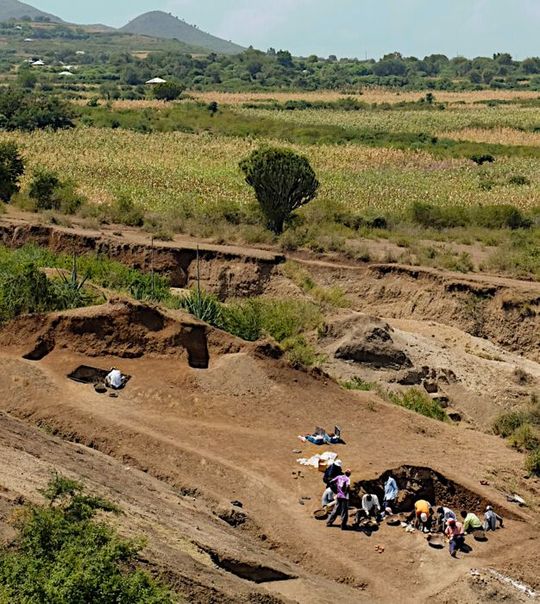
Along the shores of Africa’s Lake Victoria in Kenya roughly 2.9 million years ago, early human ancestors used some of the oldest stone tools ever found to butcher hippos and pound plant material, according to new research.
Along the shores of Africa’s Lake Victoria in Kenya roughly 2.9 million years ago, early human ancestors used some of the oldest stone tools ever found to butcher hippos and pound plant material, according to new research led by an international team of scientists.
A new study presents what are likely to be the oldest examples of a hugely important stone-age innovation known to scientists as the Oldowan toolkit, as well as the oldest evidence of hominins consuming very large animals. Though multiple lines of evidence suggest the artifacts are likely to be about 2.9 million years old, the artifacts can be more conservatively dated to between 2.6 and 3 million years old, said lead study author Thomas Plummer of Queens College, research associate in the scientific team of the Smithsonian’s Human Origins Program.
Excavations at the site, named Nyayanga and located on the Homa Peninsula in western Kenya, also produced a pair of massive molars belonging to the human species’ close evolutionary relative Paranthropus. The teeth are the oldest fossilized Paranthropus remains yet found, and their presence at a site loaded with stone tools raises intriguing questions about which human ancestor made those tools, said Rick Potts, senior author of the study and the National Museum of Natural History’s Peter Buck Chair of Human Origins.
“The assumption among researchers has long been that only the genus Homo, to which humans belong, was capable of making stone tools,” Potts said. “But finding Paranthropus alongside these stone tools opens up a fascinating whodunnit.”
Whichever hominin lineage was responsible for the tools, they were found more than 800 miles from the previously known oldest examples of Oldowan stone tools — 2.6-million-year-old tools unearthed in Ledi-Geraru, Ethiopia. This greatly expands the area associated with Oldowan technology’s earliest origins. Further, the stone tools from the site in Ethiopia could not be tied to any particular function or use, leading to speculation about what the Oldowan toolkit’s earliest uses might have been.
Through analysis of the wear patterns on the stone tools and animal bones discovered at Nyayanga, Kenya, the team behind this latest discovery shows that these stone tools were used by early human ancestors to process a wide range of materials and foods, including plants, meat and even bone marrow.
The Oldowan toolkit includes three types of stone tools: hammerstones, cores and flakes. Hammerstones can be used for hitting other rocks to create tools or for pounding other materials. Cores typically have an angular or oval shape, and when struck at an angle with a hammerstone, the core splits off a piece, or flake, that can be used as a cutting or scraping edge or further refined using a hammerstone.
Gallery
“With these tools you can crush better than an elephant’s molar can and cut better than a lion’s canine can,” Potts said. “Oldowan technology was like suddenly evolving a brand-new set of teeth outside your body, and it opened up a new variety of foods on the African savannah to our ancestors.”
Potts and Plummer were first drawn to the Homa Peninsula in Kenya by reports of large numbers of fossilized baboon-like monkeys named Theropithecus oswaldi, which are often found alongside evidence of human ancestors. After many visits to the peninsula, a local man named Peter Onyango working with the team suggested they check out fossils and stone tools eroding from a nearby site that was ultimately named Nyayanga after an adjacent beach.
Beginning in 2015, a series of excavations at Nyayanga returned a trove of 330 artifacts, 1,776 animal bones and the two hominin molars identified as belonging to Paranthropus. The artifacts, Plummer said, were clearly part of the stone-age technological breakthrough that was the Oldowan toolkit.
Significant Upgrade in Sophistication
Compared to the only other stone tools known to have preceded them — a set of 3.3-million-year-old artifacts unearthed at a site called Lomekwi 3, just west of Lake Turkana in Kenya — Oldowan tools were a significant upgrade in sophistication. Oldowan tools were systematically produced and often fashioned using what is known as “freehand percussion,” meaning the core was held in one hand and then struck with a hammerstone being wielded by the opposing hand at just the right angle to produce a flake — a technique that requires significant dexterity and skill.
By contrast, most of the artifacts from Lomekwi 3 were created by using large stationary rocks as anvils, with the toolmaker either banging a core against the flat anvil stone to create flakes or by setting the core down on the anvil and striking it with a hammerstone. These more rudimentary modes of fabrication resulted in larger, cruder and more haphazard-looking tools.
Date: 08.12.2025
Naturally, we always handle your personal data responsibly. Any personal data we receive from you is processed in accordance with applicable data protection legislation. For detailed information please see our privacy policy.
Consent to the use of data for promotional purposes
I hereby consent to Vogel Communications Group GmbH & Co. KG, Max-Planck-Str. 7-9, 97082 Würzburg including any affiliated companies according to §§ 15 et seq. AktG (hereafter: Vogel Communications Group) using my e-mail address to send editorial newsletters. A list of all affiliated companies can be found here
Newsletter content may include all products and services of any companies mentioned above, including for example specialist journals and books, events and fairs as well as event-related products and services, print and digital media offers and services such as additional (editorial) newsletters, raffles, lead campaigns, market research both online and offline, specialist webportals and e-learning offers. In case my personal telephone number has also been collected, it may be used for offers of aforementioned products, for services of the companies mentioned above, and market research purposes.
Additionally, my consent also includes the processing of my email address and telephone number for data matching for marketing purposes with select advertising partners such as LinkedIn, Google, and Meta. For this, Vogel Communications Group may transmit said data in hashed form to the advertising partners who then use said data to determine whether I am also a member of the mentioned advertising partner portals. Vogel Communications Group uses this feature for the purposes of re-targeting (up-selling, cross-selling, and customer loyalty), generating so-called look-alike audiences for acquisition of new customers, and as basis for exclusion for on-going advertising campaigns. Further information can be found in section “data matching for marketing purposes”.
In case I access protected data on Internet portals of Vogel Communications Group including any affiliated companies according to §§ 15 et seq. AktG, I need to provide further data in order to register for the access to such content. In return for this free access to editorial content, my data may be used in accordance with this consent for the purposes stated here. This does not apply to data matching for marketing purposes.
Right of revocation
I understand that I can revoke my consent at will. My revocation does not change the lawfulness of data processing that was conducted based on my consent leading up to my revocation. One option to declare my revocation is to use the contact form found at https://contact.vogel.de. In case I no longer wish to receive certain newsletters, I have subscribed to, I can also click on the unsubscribe link included at the end of a newsletter. Further information regarding my right of revocation and the implementation of it as well as the consequences of my revocation can be found in the data protection declaration, section editorial newsletter.
Over time, the Oldowan toolkit spread all the way across Africa and even as far as modern-day Georgia and China, and it was not meaningfully replaced or amended until some 1.7 million years ago when the hand-axes of the Acheulean first appeared.
As part of their study, the researchers conducted microscopic analysis of wear patterns on the stone tools to determine how they were used, and they examined any bones seen to exhibit potential cut marks or other kinds of damage that might have come from stone tools.
The site featured at least three individual hippos. Two of these incomplete skeletons included bones that showed signs of butchery. The team found a deep cut mark on one hippo’s rib fragment and a series of four short, parallel cuts on the shin bone of another. Plummer said they also found antelope bones that showed evidence of hominins slicing away flesh with stone flakes or of having been crushed by hammerstones to extract marrow.
The analysis of wear patterns on 30 of the stone tools found at the site showed that they had been used to cut, scrape and pound both animals and plants. Because fire would not be harnessed by hominins for another 2 million years or so, these stone toolmakers would have eaten everything raw, perhaps pounding the meat into something like a hippo tartare to make it easier to chew.
Using a combination of dating techniques, including the rate of decay of radioactive elements, reversals of Earth’s magnetic field and the presence of certain fossil animals whose timing in the fossil record is well established, the research team was able to date the items recovered from Nyayanga to between 2.58 and 3 million years old.
“This is one of the oldest if not the oldest example of Oldowan technology,” Plummer said. “This shows the toolkit was more widely distributed at an earlier date than people realized, and that it was used to process a wide variety of plant and animal tissues. We don’t know for sure what the adaptive significance was but the variety of uses suggests it was important to these hominins.”
The discovery of teeth from the muscular-jawed Paranthropus alongside these stone tools begs the question of whether it might have been that lineage rather than the Homo genus that was the architect of the earliest Oldowan stone tools, or perhaps even that multiple lineages were making these tools at roughly the same time.
The excavations behind this study offer a snapshot of the world humans’ ancestors inhabited and help illustrate the ways that stone technology allowed these early hominins to adapt to different environments and, ultimately, give rise to the human species.
“East Africa wasn’t a stable cradle for our species’ ancestors,” Potts said. “It was more of a boiling cauldron of environmental change, with downpours and droughts and a diverse, ever-changing menu of foods. Oldowan stone tools could have cut and pounded through it all and helped early toolmakers adapt to new places and new opportunities, whether it’s a dead hippo or a starchy root.”
This research was supported by funding from the Smithsonian, the Leakey Foundation, the National Science Foundation, the Wenner-Gren Foundation, the City University of New York, the Donner Foundation and the Peter Buck Fund for Human Origins Research.
Reference: Expanded geographic distribution and dietary strategies of the earliest Oldowan hominins and Paranthropus; Science; DOI:10.1126/science.abo7452




:quality(80)/p7i.vogel.de/wcms/aa/39/aa398d3e6667bdb43ad57abf38dc394c/0129347450v2.jpeg "An illustration shows a strand of engineered DNA passing through a nanoscale sensor, where its physical structure can be decoded as digital information. DNA nanostructures could one day serve as ultra-dense carriers of digital information and advance the field of data encryption. (Source: Jason Drees/ ASU)")
:quality(80)/p7i.vogel.de/wcms/06/a1/06a11f1d752afb35854aa9e1afb62e98/0129209625v2.jpeg "“Unsinkable\" metal tube made from chemically-etched aluminum floats in distilled water at the lab of University of Rochester professor Chunlei Guo. (Source: J. Adam Fenster / University of Rochester)")
:quality(80)/p7i.vogel.de/wcms/6d/df/6ddf023361ec7f8fbfb6c56521577960/0129056554v2.jpeg "The evolution of carburization (depicted by the spheres) under kinetic control (illustrated by the surface contours). The molecular beams represent gas evolution under synthesis conditions while the fiery sphere highlights the formation of the pure tungsten semi-carbide phase with additional molecular beams at the top to illustrate its catalytic performance. (Source: Sinhara M. H. D. Perera)")
:quality(80)/p7i.vogel.de/wcms/26/3d/263d97f8f2797267ecf2781b56882758/0129056451v1.jpeg "A study by the Complexity Science Hub finds that AI systems are already involved in nearly one-third of newly written software code, with rapid adoption in the United States and Europe and measurable productivity gains mainly for experienced developers. (Source: free licensed)")
:quality(80)/p7i.vogel.de/wcms/21/03/21030cc2541c455da0769decca8d1f82/0129146048v2.jpeg "Vyon porous plastics from Porvair Sciences are the perfect material for filtration applications in the healthcare and medical device market. (Source: Porvair Sciences)")
:quality(80)/p7i.vogel.de/wcms/bd/aa/bdaae5b9d381e2471ab37f479ad43d79/0129143884v2.jpeg "The Solvent Line Monitor from Testa Analytical is a true plug-and-play addition to any HPLC system designed to detect when one or more of its pump solvent reservoirs are empty and automatically shut-off the system. (Source: Testa Analytical)")
:quality(80)/p7i.vogel.de/wcms/8f/66/8f66b8acbb3037ca8e6b320bcad1c817/0129118043v2.jpeg "The Plasmaquant 9200 series is ideal for applications in research, trace analysis and quality control. (Source: Analytik Jena )")
:quality(80)/p7i.vogel.de/wcms/66/82/66825163ab842baded640db1a484e729/0129117548v2.jpeg "Biotech Fluidics has announced the Smartsaver solvent recycling unit which is designed to recover up to 90 % of your mobile phase by redirection of the pure solvent to the solvent reservoir during isocratic HPLC. (Source: Biotech Fluidics )")
:quality(80)/p7i.vogel.de/wcms/1a/4f/1a4fe7f8b5541716ba908251738beca1/0129349759v2.jpeg "Krict’s Syngas-to-Sustainable Aviation Fuel (SAF) Conversion Facility (Source: Korea Research Institute of Chemical Technology (Krict))")
:quality(80)/p7i.vogel.de/wcms/d4/29/d429a973c6f14ced3d2eb44931669a78/0129348927v1.jpeg "Cage-like ulva biochar confined synthesis of Fe₃O₄/ZnO heterojunction nanoparticles for synergistic adsorption and photocatalytic degradation of PFOA
(Source: Hua Jing et. al.)")
:quality(80)/p7i.vogel.de/wcms/86/90/8690b8154a552da13b37f289349b1db4/0129283446v2.jpeg "Lina Pérez-Ángel holds two sediment samples whose ages are separated by about a million years. (Source: Ellen Jorgensen)")
:quality(80)/p7i.vogel.de/wcms/90/f8/90f8c3152a59205a7cac1cc182eb186b/0129209634v2.jpeg "Nitrate in drinking water linked to increased dementia risk while nitrate from vegetables is linked to a lower risk, researchers find . (Source: free licensed)")
:quality(80)/p7i.vogel.de/wcms/84/2c/842c7c1678ceeec7147ea3a36e238e75/0129356324v2.jpeg "Kaust and Nadec have signed a MOU that establishes a framework for long-term cooperation across agricultural research, technology development, and professional training. (Source: Kaust )")
:quality(80)/p7i.vogel.de/wcms/d1/3c/d13c2ad34af600dbd360c0bb0990b922/0129045715v2.jpeg "Replacing animal products with plant-based foods helps reduce the risk of heart disease and type 2 diabetes, finds a new review by the Physicians Committee for Responsible Medicine. (Source: Pixabay)")
:quality(80)/p7i.vogel.de/wcms/e1/b3/e1b3e26d03101ba93b76b304da150c9a/0129025388v2.jpeg "The research reanalyzed data from a seminal clinical trial, led by US National Institutes of Health veteran Dr Kevin Hall, which first exposed how eating exclusively UPFs results in excessive calorie consumption and weight gain. (Source: Pixabay)")
:quality(80)/p7i.vogel.de/wcms/75/db/75db8afe45607bee750df705e22b60e9/0128938816v1.jpeg "A new academic review suggests that bamboo shoots could offer significant health benefits, including improved blood sugar control, gut health and antioxidant activity. (Source: free licensed)")
:quality(80)/p7i.vogel.de/wcms/14/24/14247b96901bfab6c75b7a3453ecfc6e/0129390600v2.jpeg "The US study, ‘Artificial-Intelligence-Enabled Digital Stethoscope Improves Point-of-Care Screening for Moderate to Severe Valvular Heart Disease’, was recently published on Thursday 5 February, 2026 in the European Heart Journal - Digital Health. (Source: Pixabay)")
:quality(80)/p7i.vogel.de/wcms/0d/9b/0d9bcd7e41846276db862456d619edd2/0129351002v2.jpeg "A Caltech-led team has developed a way of making bubble bots with simple protein shells that can be modified by enzymes or magnetic nanoparticles for efficient drug delivery. One version the researchers has made is \"smart\" enough to direct itself to direct itself to a tumor target. (Source: Gao Lab/ Caltech)")
:quality(80)/p7i.vogel.de/wcms/1a/ee/1aee2613e1a69c73ab568ee61d354ded/0129347044v1.jpeg "The Tonks lab studied PTP1B inhibition in a mouse model of Alzheimer’s disease. When PTP1B was deleted, as shown in the bottom row, the brain’s immune cells (green) were better at engulfing harmful amyloid-β plaques (grey), as shown in the left column. (Source: Nicholas Tonks/ CSHL)")
:quality(80)/p7i.vogel.de/wcms/fe/b7/feb7e0d151036b0c2be071e958dbce3b/0129341435v2.jpeg "As youth mental health challenges have risen alongside increased social media use, researchers and policymakers have questioned whether platforms contribute to emotional distress. (Source: Pixabay)")
:quality(80)/images.vogel.de/vogelonline/bdb/1710600/1710675/original.jpg "Discover how to set yourself up for success when performing balance-based density determination of solids such as jewelry and precious metals. (Mettler Toledo)")
:quality(80)/images.vogel.de/vogelonline/bdb/1682500/1682579/original.jpg "The new XPR Analytical balance redesigned to meet the needs of laboratory technicians of working fast and lean. (Mettler Toledo)")
:quality(80)/images.vogel.de/vogelonline/bdb/1677000/1677080/original.jpg "Enhance your weighing accuracy, comfort and productivity with the redesigned XPR Analytical balance. (Mettler Toledo)")
:fill(fff,0)/p7i.vogel.de/companies/5f/3f/5f3f63ceedc78/knf-logo.jpg "KNF_Logo.jpg (www.knf.com)")
:quality(80)/p7i.vogel.de/wcms/a8/0f/a80fceff61d175115a7b84c26831a2fb/0109697036.jpeg "Examples of an Oldowan percussive tool, core and flakes from the Nyayanga site. (Top row) Percussive tool found in 2016. (Second row from top) Oldowan core found in 2017. (Bottom rows) Oldowan flakes found in 2016 and 2017.(Source: T.W. Plummer, J.S. Oliver, and E. M. Finestone, Homa Peninsula Paleoanthropology Project)")
:quality(80)/p7i.vogel.de/wcms/20/94/209436ea41574b014e518a19f0fbe6ec/0109697035.jpeg "Paranthropus molars recovered from Nyayanga site. Left upper molar (top) was found on the surface at the site, and the left lower molar (bottom) was excavated.(Source: S. E. Bailey, Homa Peninsula Paleoanthropology Project)")
:quality(80)/p7i.vogel.de/wcms/3a/5c/3a5c67538edad916ca633c84b8ea8f3f/0109208223.jpeg "A new finding implies that individuals with very different profiles and backgrounds were living in the same region of Siberia around the same time. (Source: Sergey V. Semenov)")
:quality(80)/p7i.vogel.de/wcms/b6/79/b679d9fc74c03792eb434f115ce41a25/0124983990v2.jpeg "An illustration of Cretaceous Period birds with other dinosaurs from the same time period in the background. A paper in the journal Science documents the earliest-known example of birds nesting in the polar regions. (Source: Gabriel Ugueto)")
:quality(80)/p7i.vogel.de/wcms/1c/f1/1cf15c99760c32158a4731b97487fd0a/0126113439v2.jpeg "Archaeological sheep bones unveiled at a Bronze Age site in the Eurasian steppe. Bones like these are the key to understanding the origins of zoonotic infectious diseases. (Source: Björn Reichhardt)")